

A multimeter tells you a cell’s voltage, and a dead-looking battery can still read 1.5 V with no load on it. The BT-168 battery tester answers a different question: is this cell still good enough to sell, to use, or to send back to the supplier? Its needle settles into a coloured scale and the answer is immediate.
We produce the BT-168 series, in the BT-168 and BT-168D variants, at our Wenzhou factory. The thresholds below are printed on the tester’s own scale from our production specification. This guide is for the store or service desk that handles returned batteries and wants to end the argument, and for the distributor deciding whether a battery tester earns a slot in the catalogue.
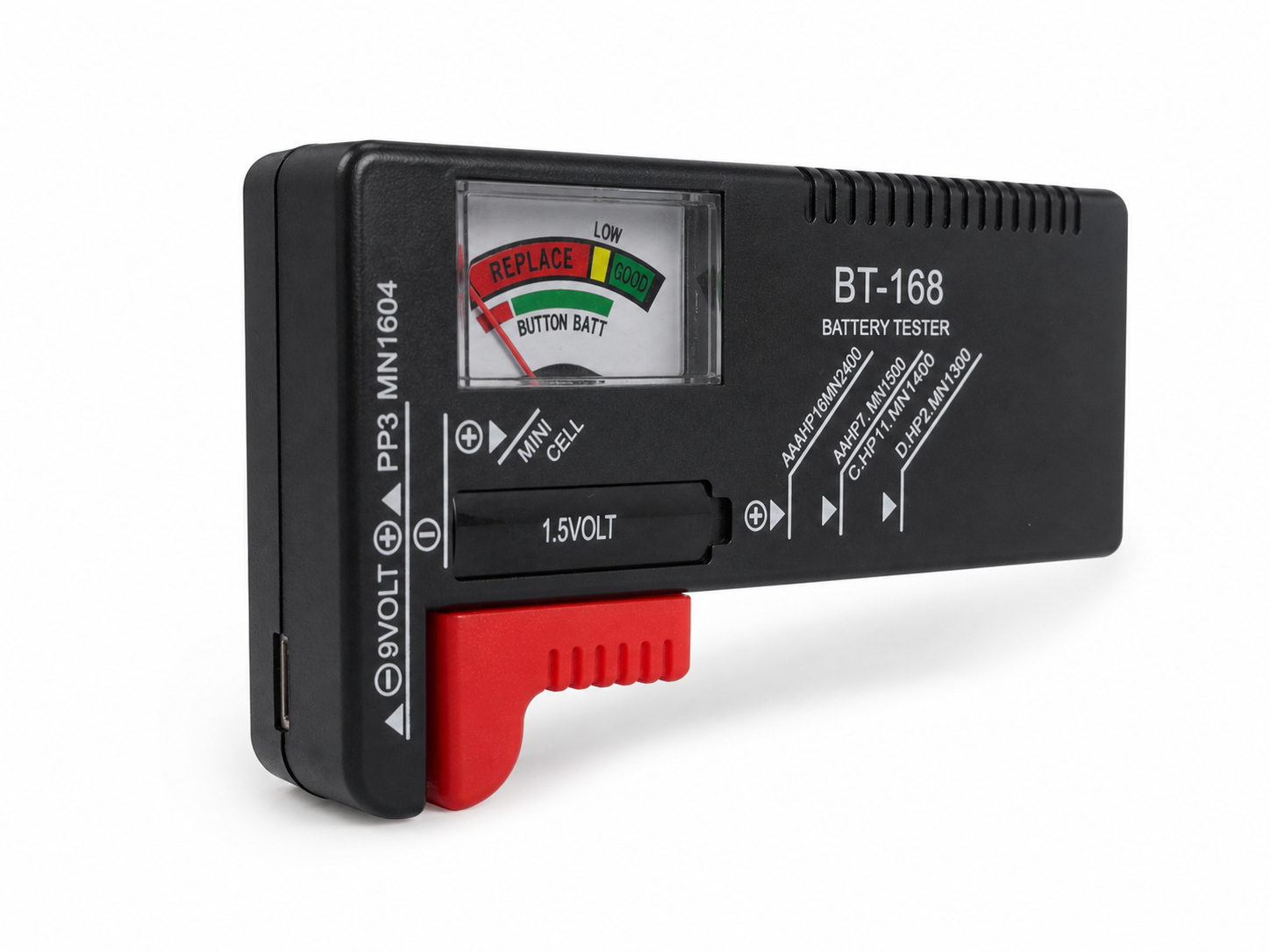
What the Needle Tells You
The tester checks the common household sizes: 1.5 V AAA, AA, C and D cells, small button batteries, and 9 V types such as 6F22, PP3 and MN1604. The tester needs no battery of its own, because the cell under test provides the power that moves the needle.
For a 1.5 V cell the scale reads three zones: good from 1.28 V to 1.5 V, weak from 1.15 V to 1.27 V, and replace below about 1.14 V. For a 9 V battery the numbers scale up: good from 7.8 V to 9 V, weak from 6 V to 7.7 V, and replace below about 5.9 V. Colour the zones green, yellow and red and the message needs no training to read.
That is the point of a dedicated tester over a multimeter. A multimeter measures the cell at rest, which is why an exhausted cell can still show a healthy voltage. The BT-168 reads the cell the way a device will use it, which is the reading that decides whether the battery belongs in the drawer or the recycling box. If you need the full voltage and current story, keep a multimeter for that; the tester is for the fast yes-or-no decision.
Where the BT-168 Earns Its Keep
The first place is a returns counter. A customer brings back batteries that “died too fast”; instead of arguing or refunding on faith, staff test the cell in front of them and show the needle in the replace zone. The dispute ends without a discount. Hardware stores, electronics shops and battery retailers use the same trick to screen their own stock before it reaches the shelf.
The second place is a service bench. A smoke detector, a wall clock, a remote control or a kitchen scale comes in not working, and the fastest first check is whether the batteries inside are actually delivering. One push of the button answers it before you open the device.
For a distributor, the series is a small, light add-on line rather than a freight-heavy one. At 112 by 61 by 27 mm and 48 g, a BT-168 fits the same carton space as a handful of batteries, and it sells next to the batteries themselves. OEM branding and packaging are available when you order it under your own label.
What It Is Not
The BT-168 is not a battery charger or an analyser. It does not measure capacity in milliamp-hours, it will not test rechargeable packs with terminals it does not list, and its working range is 0 to 40 °C at 25% to 80% relative humidity, so it belongs on a shelf rather than in a damp workshop corner. Read the scale for what it is: a fast good, weak or replace verdict on the standard household sizes.
It also complements rather than replaces the broader test range. For the meters and testers a battery retailer already stocks, the BT-168 slots alongside the general instruments your customers already buy from you.
Keep One Where the Returns Come In
If you stock batteries, put a BT-168 where the returns desk can reach it, and use it on the next few returns that come in. Note how often the needle lands in the replace zone versus a genuinely faulty product. Then send us what you find, the battery sizes that move through your store, and the quantity you want to start with. Our Wenzhou engineers reply within 24 hours, confirm the BT-168 fits your counter, and quote per-unit pricing once we have your numbers.