

Ignition Coil Resistance: What a Multimeter Should Read
An ignition coil holds two windings of copper around a laminated iron core, and a multimeter can see both of them. The primary winding across the two low-tension pins usually measures somewhere between 0.4 and 2 ohms, the secondary winding from the high-tension tower to one of those pins usually measures in the low kilohms, and both windings should be completely isolated from each other and from the core. Those three readings answer most of the questions a misfire raises. What they cannot answer is whether the coil breaks down once it is hot and carrying current, and that limitation is the single most important thing to understand before you condemn a part.
The measurements below come from the resistance behaviour of the instruments we build and from the winding values that ignition coils in service actually present. Wenzhou Zhengyuan Electronic Co., Ltd. manufactures these meters in its Wenzhou factory.
What Each Reading on an Ignition Coil Means
Every measurement is taken with the coil disconnected from the harness and the engine cold. A coil still wired to the vehicle is being measured through the rest of the ignition circuit, and the number you get will not mean anything.
| What you measure | What a healthy coil reads | What it means |
|---|---|---|
| Across the two low-tension pins | 0.4 to 2 ohms, most often 0.5 to 1.5 | The primary winding is intact. A reading far above this band points to corrosion or a failing winding; OL means it is open. |
| High-tension tower to either low-tension pin | Roughly 5 to 15 kilohms | The secondary winding is intact. One pin will read in this band and the other may read open, depending on the coil. |
| Between the primary pins and the tower | OL | The two windings are correctly isolated from each other. |
| Either winding to the iron laminations | OL | The winding is correctly isolated from the core. |
| Primary reads OL | OL | Open primary winding. The coil will not fire at all and no other test is needed. |
| Secondary reads OL to both pins | OL | Open secondary winding. Same conclusion, different winding. |
| All windings correct, engine still misfires | Correct on every test | The coil may still be faulty. Resistance testing cannot see insulation that breaks down only under load. |
The last row is the one that decides whether a resistance test was worth doing. It is a filter, not a verdict. A coil that fails it is definitely bad; a coil that passes it is only cleared of the failures a meter can see.
Primary and Secondary Are Two Different Measurements
The primary is a few hundred turns of thick wire and the secondary is many thousands of turns of very fine wire, which is why the two windings differ by four orders of magnitude. That difference is also why you cannot test both on the same range. Set the meter to its lowest resistance range for the primary and to a kilohm range for the secondary, and change ranges between the two rather than leaving it on autorange and hoping.
The primary reading is the one that carries the diagnostic weight, because it is small enough that a poor connection can swamp it and large enough that a shorted turn changes it visibly. A primary that reads 0.8 ohms where the specification says 1.2 is worth a second look; a primary that reads 3 ohms where the specification says 1.2 is a terminal or a corroded pin far more often than it is a failed winding.
Why a Third of an Ohm of Test Lead Ruins a 0.8 Ohm Reading
Test leads have resistance, and it sits in series with whatever you are measuring. A worn pair can easily contribute 0.2 to 0.4 ohms. Against a 1.2 ohm primary that is a quarter of the reading, and against a 0.8 ohm primary it is closer to half. The measurement is not wrong in the sense of being broken; it is wrong in the sense of answering a slightly different question than the one you asked.
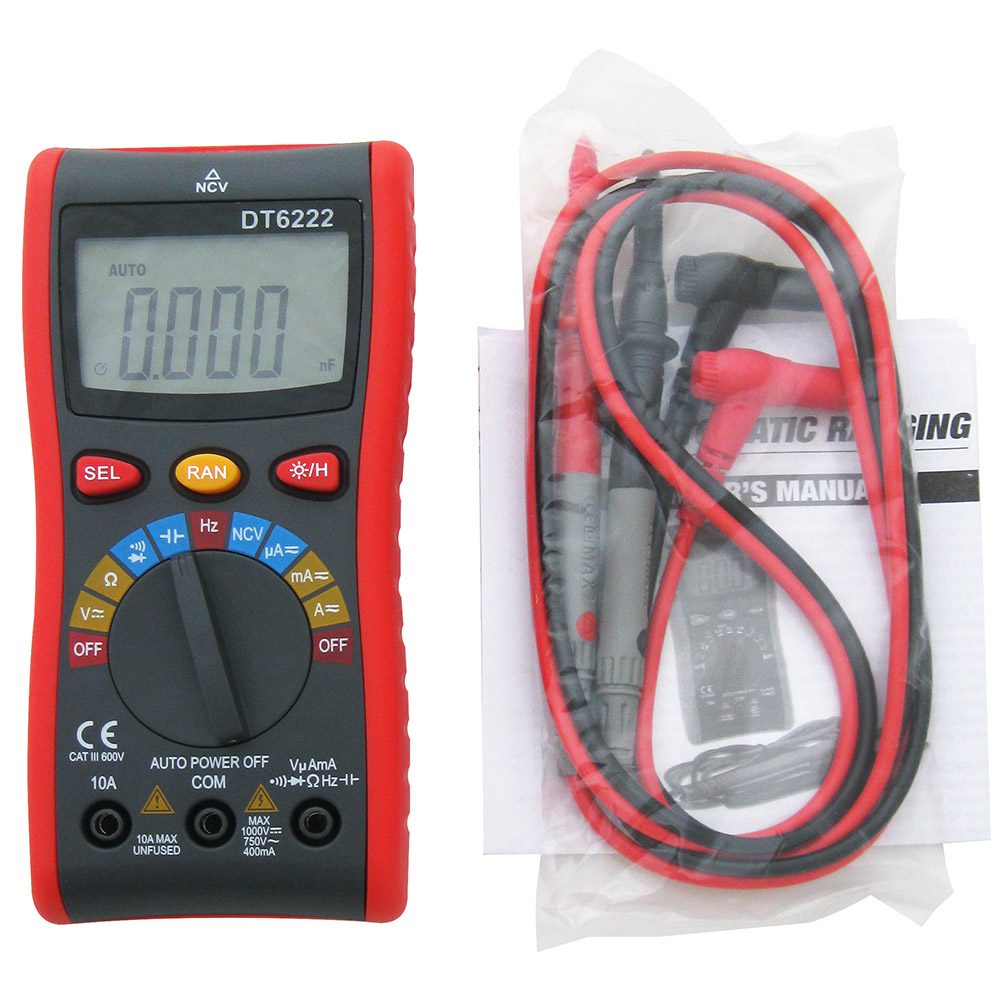
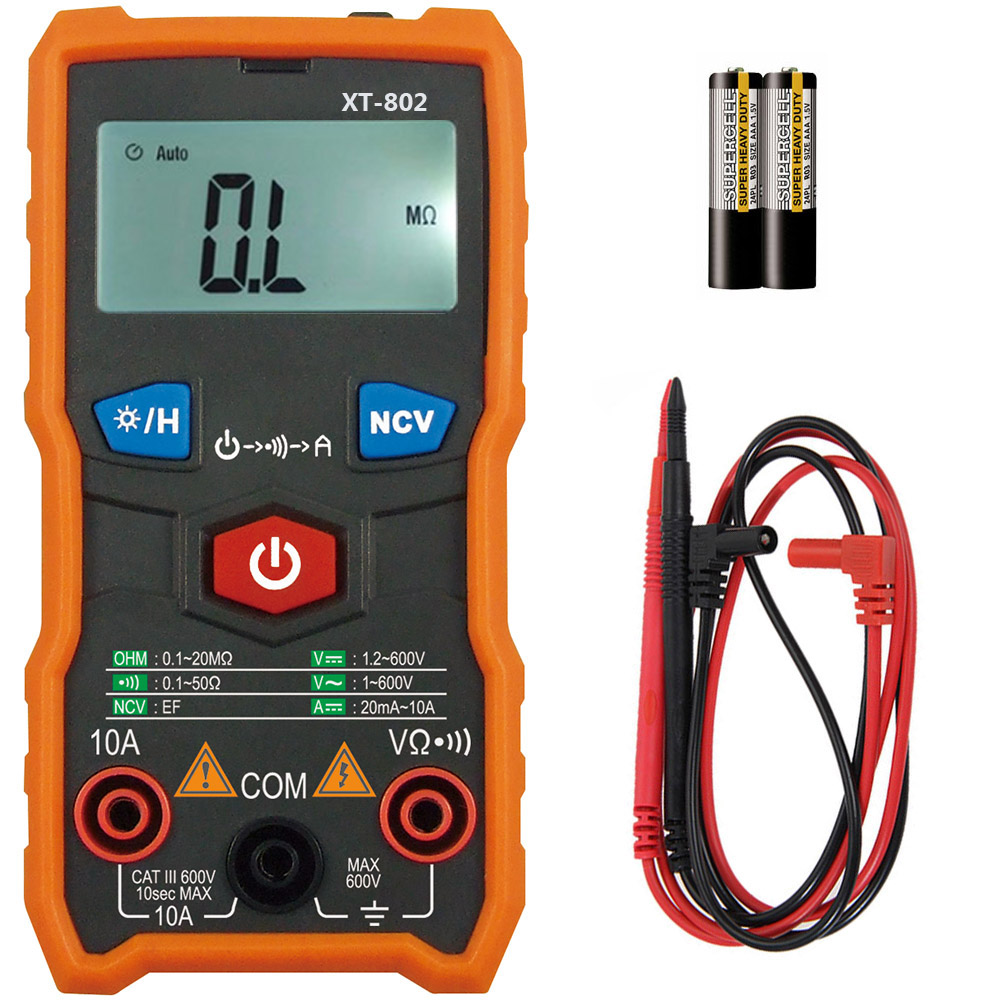
The fix costs a few seconds. Touch the two probe tips firmly together, read what the meter says, and subtract that from every low-ohm reading you take afterwards. A good pair reads under 0.2 ohms. Anything higher and you are measuring your leads as much as the coil. The DT6222 resolves to a tenth of an ohm on its 400 ohm range at plus or minus 1.2 percent, which is enough precision for a primary winding; the XT802 resolves to the same tenth of an ohm at plus or minus 2.0 percent. Either is adequate. Neither is adequate if you forget the leads.
A Coil That Passes Every Resistance Test Can Still Be Faulty
A coil fails in two quite different ways. The windings can open or short, which a meter sees immediately. Or the insulation inside the coil can break down once the winding is hot and the voltage across it is high, which a meter at room temperature with a 9 volt battery behind it will never see. The second failure is the more common one on a modern engine, and it is why a misfire that only appears under load or after twenty minutes of running is not cleared by a clean resistance reading.
What a resistance test does is remove the cheap possibilities. If the primary is open, you are finished and you do not need to think about insulation. If both windings and both isolation checks are correct, the coil moves from suspect to possible and the diagnostic effort should move to the plug, the boot, the harness and the ignition module. The automotive multimeter guide sets out the same order of operations for the rest of the ignition circuit.
Measuring a Coil-On-Plug Coil
A coil-on-plug coil has no high-tension lead, so the secondary is reached through the tower that sits directly on the plug. Measure the primary across the two low-tension pins as usual, then measure from the tower to each of those pins in turn. One of them will return a reading in the kilohm range and that is your secondary winding; the other may return OL, which is normal rather than a fault. This is the point where a coil that looks completely open turns out to be fine, and it is worth doing both measurements before drawing a conclusion.
Inspect the boot while you have the coil out. Carbon tracking down the inside of the boot is a genuine failure mode that no resistance measurement will show, and it looks like a thin dark line or a grey deposit along the path the spark took. A coil with a tracked boot will often test perfectly and misfire only in damp weather. The automotive electrical testing guide covers the rest of the ignition-side checks in the same order.
Temperature, Contact and the Readings That Look Wrong
Copper resistance rises with temperature at roughly four tenths of a percent per degree Celsius. Between a cold engine and a heat-soaked one that is a change of several percent on a primary winding, which is small enough to ignore for a go/no-go decision and large enough to explain a reading that sits just outside a tight specification. Measure cold, and measure consistently cold, if you intend to compare against a published figure.
Contact quality is the larger variable. A probe resting on a plated pin reads differently from the same probe pressed into it, and a pin that has been sitting in an engine bay reads differently again once the film on it is broken. When a reading looks wrong, re-seat the probes and take it again before you believe it. That single habit accounts for more rescued coils than any other step in this procedure.
Send Us the Readings You Took
If you are selecting meters for an automotive workshop, a service chain or a distributor’s range, order a sample and run a known-good coil and a known-bad one through the procedure above, then tell us which instrument made the difference between them obvious. Send the readings you took, what your technicians actually use the meter for, and the quantity you are planning. Our Wenzhou engineers reply within 24 hours, confirm whether the DT6222 or the DT700D fits the work you are equipping, and quote per-unit pricing once we have your numbers.