


When you search for a digital multimeter supplier in China, you find two kinds of companies. Factories that actually make the meters, and trading companies that resell someone else’s products. Both can deliver working units. But for a business buying in bulk, the gap in price, quality control and flexibility is big enough to make or break your sourcing project.
What is the difference between a factory and a trading company?
A factory owns the production line. It designs the circuit, sources the components, calibrates the meters, and controls quality at every step. A trading company owns a catalog. It takes your order, buys from a factory, adds a margin, and handles the paperwork. You may never know which factory actually built your shipment.
Neither model is dishonest on its own. Trading companies have a real place in international trade. The problem appears when you pay factory-direct prices but receive trading-company margins, or when you need a change and the trader cannot make it happen because they do not control production.
Why this matters for digital multimeters
Digital multimeters are a commodity category with tight margins. If you import them in volume, every cent of overpayment multiplies across your stock. A few real differences:
- Price. Selling direct removes one or two middlemen. For a standard model like the DT830 series, that difference is often several percent on large orders.
- Quality consistency. A factory calibrates each unit against a standard. A trader buys mixed batches, sometimes from different factories, so consistency varies.
- OEM work. Printing your logo, changing the color, customizing the range or the packaging. This is routine for a factory. A trader usually cannot do it, because the factory behind them will not cooperate.
- After-sales. If a batch fails, you talk to the person who built it, not to someone who needs to call a third party.
Five checks to confirm you are talking to a real factory
- Ask for the production address and look it up. A real factory sits in an industrial zone and its address matches its claimed scale. A trading office is often in a commercial building.
- Ask for fresh photos or video of the production line. Real factories can show you the actual line, the calibration bench, the packing area. Ask for today’s date written on a whiteboard in the shot.
- Talk specifications. A factory can discuss the chipset, the calibration procedure, the mold for the housing. A trader talks price and delivery only.
- Ask for certifications and check them. CE, RoHS, ISO 9001. Then verify the certificate number with the issuing body.
- Request a small custom change. If they print your logo and adjust the packing without extra layers of approval, you are likely dealing with the maker.
Case study: the DT830 series, direct from the factory
Take a classic entry-level meter, the DT830 series. We have built this model in our Wenzhou factory since 2008.
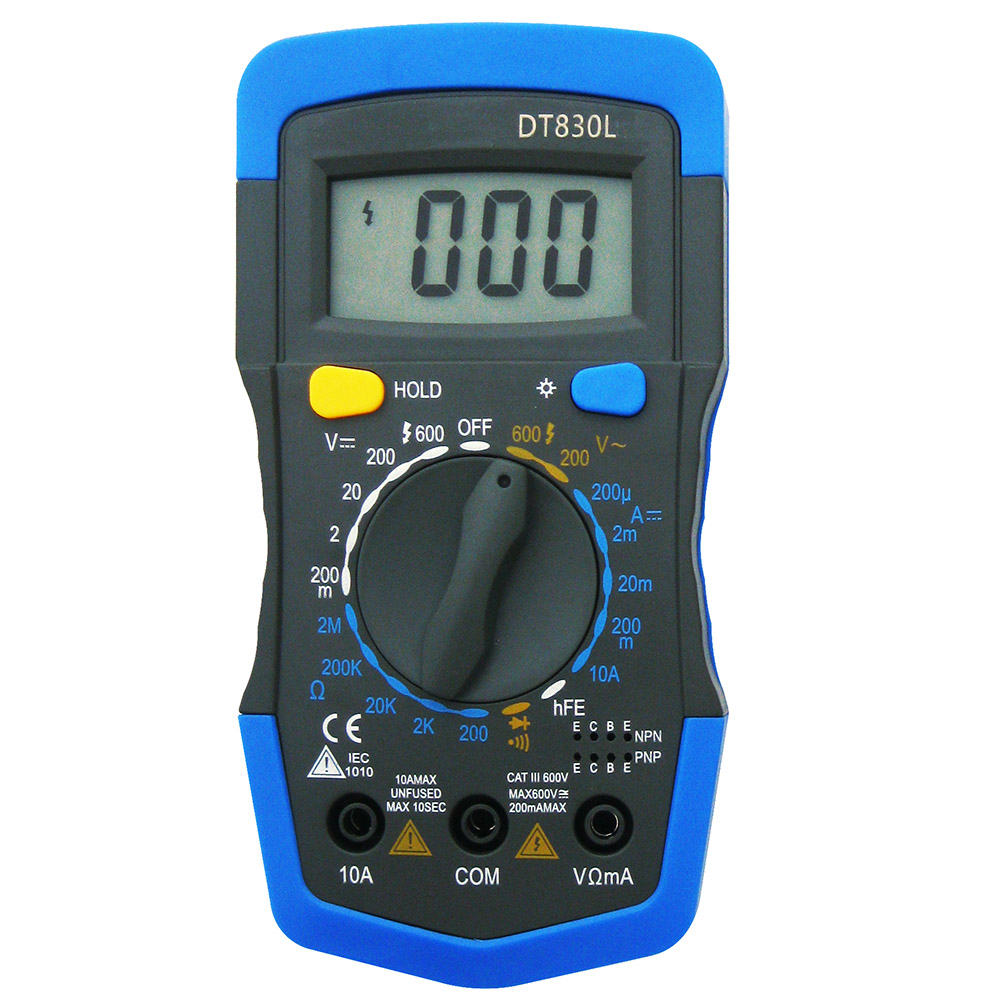
The DT830L offers a 1999-count, 3 and a half digit LCD display with backlight, data hold, diode test and a continuity buzzer. It ships CE and RoHS certified under ISO 9001 processes, with OEM/ODM options for your brand. As the maker, we control calibration on every unit, and we can adjust the model for your market. If you are sourcing a volume of digital multimeters, you can request a wholesale quote directly or download the full product catalog.
Frequently asked questions
1. How do I verify a Chinese multimeter factory is real?
Ask for the production address, fresh line photos with a dated sign, and a small custom request. Real factories can show production and accommodate changes. Then verify their CE and RoHS certificates with the issuing bodies.
2. What is the minimum order quantity for digital multimeters?
MOQ depends on the model and configuration. Standard models like the DT830 series are more flexible than custom OEM versions. Tell us your quantity and target price and we will quote accordingly.
3. Can I get OEM multimeters with my own brand?
Yes. As a factory we print your logo, customize packaging, and can adjust certain specifications. OEM/ODM is a standard service on our production line.
4. What certifications do your multimeters carry?
The DT830 series ships with CE and RoHS certification, produced under ISO 9001 management. Contact us for the certificate documents.
5. How do I get a wholesale price for the DT830 series?
Send your target quantity through the inquiry form and we will reply within 24 hours with pricing, lead time and shipping options.
Related reading: DT700 Digital Multimeter Guide: DT700C vs DT700B vs DT700D