

GFI vs GFCI: Two Names for One Device, and One Number That Decides Everything
GFI and GFCI are the same device. GFCI stands for ground fault circuit interrupter, GFI for ground fault interrupter, and the shorter form exists because it fit more easily on a device face and in a contractor’s order book. There is no technical difference, no code difference and no performance difference between a GFI and a GFCI. The number that actually distinguishes one of these devices from another is the current at which it trips, and the standard fixes that number at five milliamperes with a tolerance of plus or minus one.
This matters at the point of purchase, because a buyer searching for the difference between the two names is usually trying to work out whether two products on a shelf are genuinely different. They are not. What differs is whether the device is a Class A ground fault interrupter at all, and that is a question about its listing rather than its label. Wenzhou Zhengyuan Electronic Co., Ltd. builds socket testers in Wenzhou that check these devices on site, and the distinction between checking one and certifying one is the subject of most of this article.
Where the Two Names Came From
The National Electrical Code uses ground fault circuit interrupter throughout, and the listing standard behind it, UL 943, uses the same wording. Manufacturers adopted the shorter GFI on device faces and in catalogue listings, and the trade followed. Electrical supply houses list the same stock under both headings, and a contractor who orders one and receives the other has received the same item.
The situation is different outside North America, where the equivalent device is called a residual current device, or RCD, and is governed by IEC standards rather than UL 943. An RCD and a GFCI perform the same protective function and are not interchangeable as products, because they are built and listed to different standards and fit different installation systems.
The Number That Defines the Device
A ground fault interrupter works by comparing the current leaving on the live conductor with the current returning on the neutral. In a healthy circuit those two are equal. When current escapes to earth through a person, a wet surface or a failing insulation, the two stop being equal, and the device trips on that difference. Class A devices are required to trip when the imbalance reaches the five milliampere level, and the standard also sets a maximum time within which the trip has to happen.
Five milliamperes is not an arbitrary figure. It sits below the level at which sustained current through a human body causes muscular contraction severe enough to prevent letting go, which is the failure mode the device exists to prevent. A device that trips at thirty milliamperes protects equipment. A device that trips at five protects people. Both are useful, and only one of them is a GFCI.
What a GFCI Does That an Overcurrent Breaker Cannot
A circuit breaker protects the wiring. It opens when current exceeds its rating for long enough to threaten the cable, and a ground fault of a few milliamps is nowhere near that threshold. A person receiving a shock through a hand and a wet floor may be drawing a small fraction of an amp while the breaker sees nothing wrong at all. The two devices answer different questions and neither substitutes for the other.
This is why ground fault protection is required in the locations where a person and a ground path are likely to meet: kitchens, bathrooms, laundries, garages, outdoors and anywhere near water. The requirement follows the hazard, not the building type.
GFCI, RCD and AFCI: Three Devices People Confuse
The three are routinely mixed up because all of them are protective devices that trip, and all of them are installed by the same person. The table separates them by what they detect.
| Device | What it detects | Where the term is used |
|---|---|---|
| GFCI | Current imbalance between live and neutral, at the five milliampere level | North America, National Electrical Code and UL 943 |
| GFI | The same thing under a shorter name | Device faces, catalogue listings and trade usage in North America |
| RCD | Current imbalance, at thresholds set by the applicable IEC standard | Europe, the United Kingdom, Australia and most of the rest of the world |
| AFCI | The characteristic high-frequency signature of an arcing fault | North America, for branch circuits where damaged cable is the hazard |
The practical consequence is that a tester built to check a North American GFCI is checking for a five milliampere trip, while an instrument aimed at a European installation is testing an RCD at a threshold that may be thirty milliamperes or three hundred. The same three lights on a tester can mean different things depending on which market it was built for.
How to Tell Whether the One in Front of You Actually Works
Every GFCI carries a test button, and pressing it is the first check. That button creates an internal imbalance and the device should trip. It is a functional check of the mechanism and nothing more: it does not verify the trip threshold, it does not verify the trip time, and it cannot detect a device whose sensing circuit has drifted.
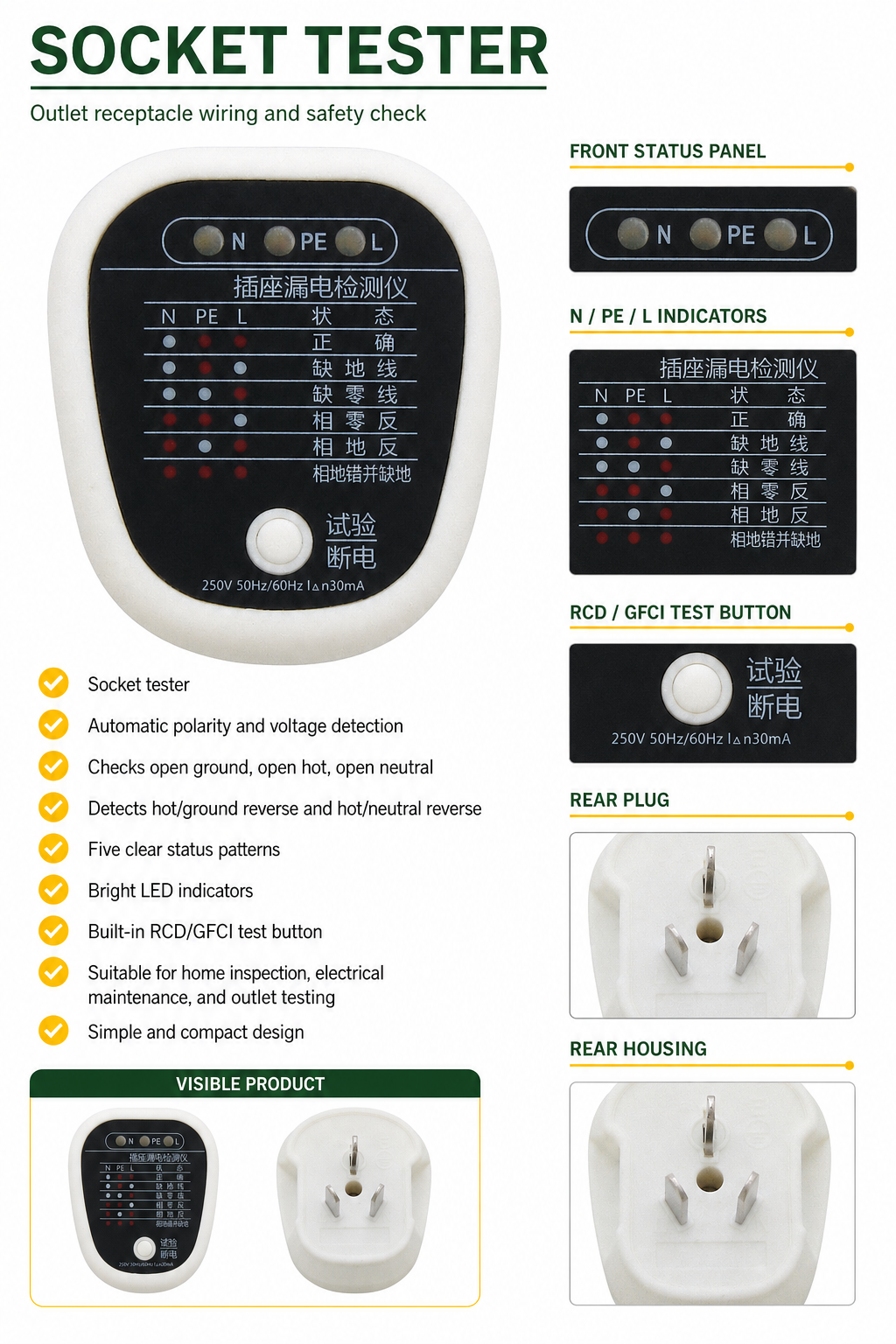
A plug-in socket tester with a ground fault test button does the same job from the outside, injecting a small leakage current into the protective conductor and watching whether the device opens. This is the check most often performed on site, and it is worth being precise about what it proves. It proves the device trips when presented with a fault. It does not prove the device trips at five milliamperes. Only an instrument that measures the actual trip current and the trip time can establish that, and that instrument costs considerably more than a socket tester.
Our outlet tester guide covers how to read the light combinations on the three-lamp testers and what each pattern indicates about the wiring behind the socket, which is the other half of the same job.
What a Socket Tester Checks, and What It Cannot
A three-lamp socket tester checks the wiring of the outlet itself: whether live and neutral are the right way round, whether the protective earth is present, and whether the earth and neutral have been swapped or bridged. Those are the faults that make an installation dangerous before anyone touches it, and they are invisible without a tester. The home wiring safety guide walks through the fault patterns in the order they are most often found.
What a tester cannot do is measure. It reports a combination of lamps, not a number. It will not tell you how much current the ground fault device actually needed to trip, and it will not tell you whether an earth connection is low-resistance or merely present. A tester that reports presence where the question was resistance is the most common way a socket tester gets over-trusted, and the fix is to know which of the two questions you asked. Our socket tester range is built around that three-lamp check, and the full socket tester category lists the variants by the market they are aimed at.
Send Us the Market You Are Selling Into
If you are selecting socket testers for a distributor’s range, the decision that matters is not the name on the device but the standard the market enforces and the fault patterns the local trade actually encounters. Tell us which country you are selling into, whether the installation uses a GFCI or an RCD, what the local plug type is, and the quantity for the first order. Our Wenzhou engineers reply within 24 hours with the model that matches your market, the lamp combination it reports, and per-unit pricing against your numbers.