

Private Label Multimeters: Which Changes Are Just Printing and Which Need a New Tool
Most private label requests never touch the inside of the meter. Front panel artwork, the colour of the holster, the carton and the manual are print and packaging decisions, and a buyer can approve them from a screen. The work moves into hardware only when a request asks for a measuring range the platform does not already carry, a different display, or an accuracy class the existing board cannot reach. Which of those two situations a brief falls into decides the sample cost, the minimum quantity and the number of weeks before the first shippable carton.
Wenzhou Zhengyuan Electronic Co., Ltd. has run private label projects for multimeters, clamp meters and voltage testers from its Wenzhou factory since 2008, across roughly 127 models and more than forty export markets. The pattern repeats. A buyer who arrives with a page of artwork and a target carton gets to production quickly. A buyer who arrives wanting a specific resolution at a specific landed price spends the first month walking back through their own requirement, because the two constraints were never compatible and nobody said so at the start. What the factory offers as standard scope is set out on the OEM and ODM page.
The Four Kinds of Change a Private Label Order Contains
Every customization request belongs to one of four groups: what appears on the outside of the instrument, what appears on the packaging, what the instrument measures, and how the instrument behaves in use. The first two are print work. The third is electrical design. The fourth sits in between and is where most of the arguments happen, because a buyer usually thinks of it as a setting while the engineering team thinks of it as a decision that affects the calibration procedure.
| Change requested | Print work only | Needs tooling or a new board | What it does to the schedule |
|---|---|---|---|
| Logo and model name on the front panel | Yes, printed on the overlay | No | Moves at the speed of artwork approval |
| Housing and holster colour | No, moulded in colour | Only if a new tone is ordered | Added to the next production run |
| Carton, blister and manual | Yes, entirely | Dies only for a new carton size | Moves at the speed of packaging approval |
| Additional measuring range | No | Yes, dial rotor and firmware | Requires a new sample round |
| Beep threshold or auto power off timing | No | Yes, firmware only | Requires a new sample round |
The table is not a rule about cost. It is a rule about sequence. Anything in the second column can run in parallel with anything else in the second column. An item in the third column stops the whole project until a sample has been built, measured and approved, because a new sample is the only way to know whether the change did what the brief asked for.
What Printing on the Front Panel Actually Involves
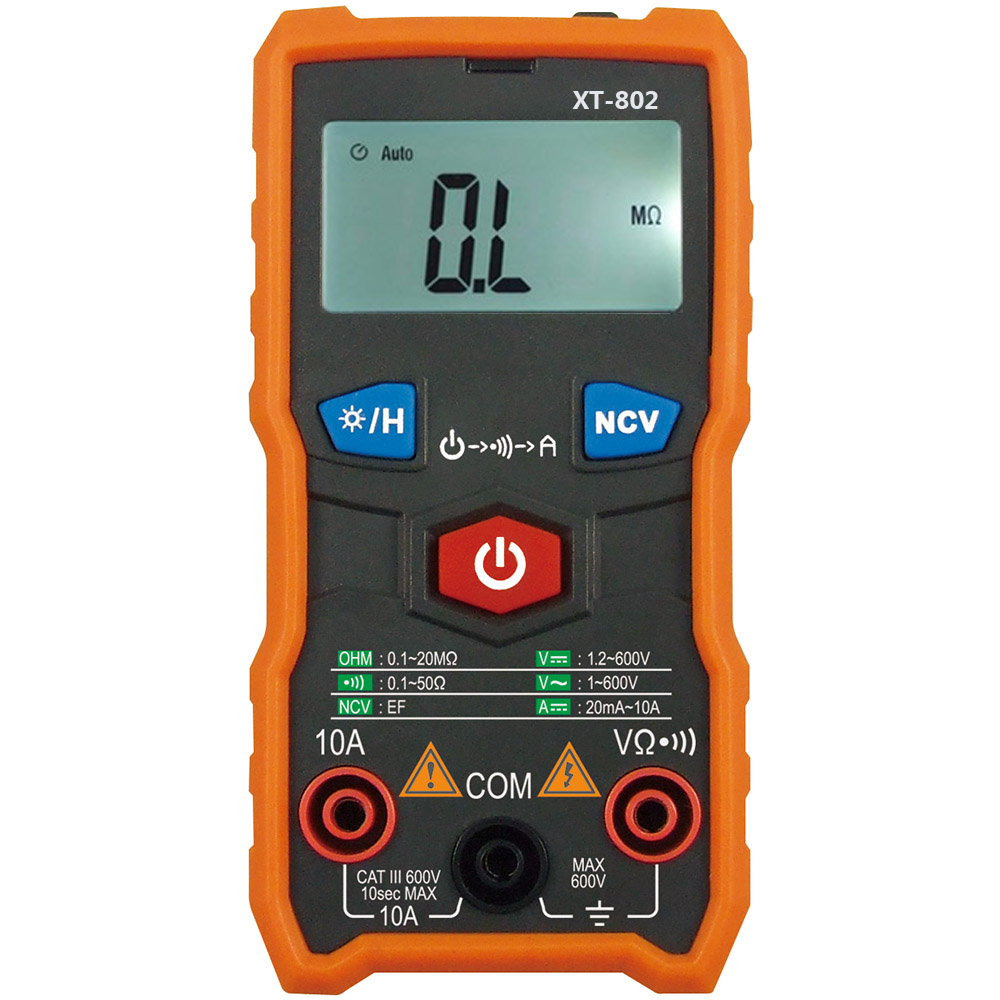
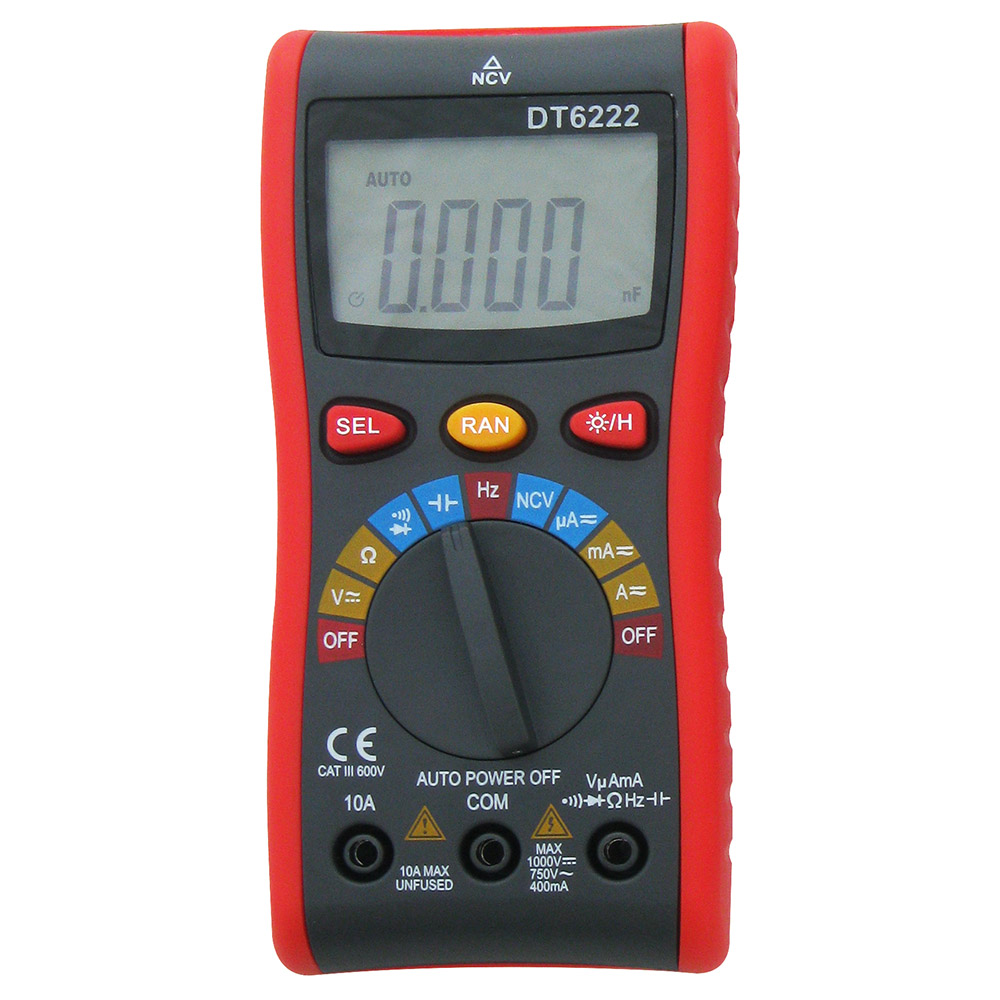
The front of a multimeter is a printed overlay bonded to a plastic carrier, and the artwork on it is a full replacement rather than a sticker. A buyer’s logo, model name, the colour of the function labels and the layout of the range arc all go into the same file, and the same file goes to the printer. There is no incremental cost for adding a marking, and no saving for leaving one out.
What does change is the proof. The overlay is printed before the meters are assembled, so an error found after printing wastes the entire print run, not one unit. That is why a digital proof comes before mass production rather than alongside it, and why the proof should be checked against the physical sample and not against a design file. Colours on a screen and colours on a bonded overlay under daylight are not the same colour, and the difference is most visible on reds and blues, which is exactly where most brand colours sit.
The physical sample matters for a second reason. The overlay is shaped to fit a specific housing, so a buyer who approves artwork on screen without holding the meter has approved a rectangle, not a panel. Curves, corners and the cut-out around the range switch are all set by the housing mould, and none of them appear in a flat artwork file.
Colour, Holster and the Parts Buyers Assume Are Free
A coloured housing is not a repaint. The pigment goes into the plastic before moulding, so a new colour means either a dedicated production batch or a mould change, depending on how far the requested tone sits from the colours already running. Holsters and button accents are separate parts, and they are usually the cheapest place to put a brand colour, because they can be swapped without touching the main mould.
The assumption worth correcting early is that colour variety is free because the unit cost does not visibly move. It does not move much per unit, but each additional colour divides a production run into smaller batches, and each batch carries its own setup. A buyer who asks for four colourways on a first order gets four smaller lots of the same article, and the practical effect lands on the minimum order per colour rather than on the price per unit.
Where a Changed Range Stops Being a Setting
A range that already exists on the platform can be enabled or disabled for a specific order. That is a configuration. A range that does not exist requires a change to the dial rotor position, the switch contacts, the input divider and the firmware that maps the reading to the display, and any of those can force a new printed circuit board revision.
The line is usually crossed by resolution rather than by range. Asking for a 600 V AC range on a platform that already measures 600 V AC changes nothing. Asking for one more digit at the same range does, because the display driver, the reference and the calibration rig all have to support it. A useful test before writing the brief is to ask whether the requested capability exists anywhere in the manufacturer’s current catalogue. If it exists on another model, it is usually a matter of moving a platform. If it exists nowhere, the project is development work and should be scoped as such.
Packaging Is Where Most Projects Actually Differ
Two buyers can order the same meter and end up with products that do not look related on a shelf. Blister packs suit impulse retail and hang on a pegboard, colour boxes suit a counter where the buyer picks the item up, gift boxes suit premium positioning, PVC pouches suit tool bags and kit assembly, and neutral cartons suit a distributor who applies their own label in their own warehouse. Each format changes the carton dimensions, and carton dimensions decide how many units fit a container. The cost side of that trade-off is broken down in what a multimeter price actually pays for.
Multilingual manuals are usually decided at the same moment as the carton, and they cost less than buyers expect once the copy is fixed. The expensive part is not translation. It is the second revision after a range change, because a manual references the ranges, and a manual that has already been printed cannot follow a change made later in the project.
What a Digital Proof Proves and What It Does Not
A digital proof confirms that the artwork file is being read the way the buyer intended. It confirms spelling, layout, colour values and the position of every marking. It does not confirm how the panel looks on a moulded housing, it does not confirm how the colour survives the bonding process, and it does not confirm that the printed overlay and the plastic carrier align once assembled.
Those three things are confirmed by the physical sample and by nothing else. Treating the digital proof as the approval gate and the sample as a formality is the single most common cause of a reprint, and a reprint is the one delay in a private label project that cannot be recovered by working faster elsewhere.
Writing a Brief That Gets Quoted the First Time
A brief that can be quoted without a follow-up conversation has five parts: the model or the closest existing model, the list of changes with artwork attached, the market the product will be sold in, the number of units in the first order and the number expected over a year, and the date the goods have to leave the factory. The last two are the ones buyers leave out, and they are the two that decide whether the answer is a price or a question.
Send those five parts through the contact form and the engineering team at our Wenzhou factory replies within 24 hours with a quotation, a sample plan and a list of anything in the brief that cannot be done at the stated volume. If the artwork is ready, ask for the digital proof in the same message. Getting the proof and the quotation in one round costs less time than getting them one after the other, and it makes the difference between a printed panel and a moulded one obvious before anybody commits to a production slot.