

A Multimeter for Electricians: The Specifications That Decide Whether It Survives the Job
An electrician’s meter is chosen by four specifications and bought on a fifth. The four are the continuity threshold, the current ranges and which jack they live on, the resistance range, and the input protection behind the jacks. The fifth is price, and it is the only one that can be judged without taking the instrument apart. A meter that is accurate on a bench and unreliable in a panel is not a cheaper meter; it is a meter whose four specifications were never matched to the work. Everything below describes how to read those four against the jobs an electrician actually does.
Wenzhou Zhengyuan Electronic Co., Ltd. builds digital multimeters and clamp meters in Wenzhou and has been shipping them since 2008. The figures quoted below are the ones printed on our own specification sheets, and the reasoning applies to any meter of the same class regardless of who built it.
What an Electrician Asks a Meter to Do That a Hobbyist Does Not
Hobbyist work is done at low voltage, indoors, on a bench, with the circuit isolated. Site work is done at line voltage, in a panel that may still be live, in a rush, with one hand holding a torch. The measurement itself is often trivial; the conditions are what make it hard. A meter that suits the first set of conditions can be entirely unfit for the second, and the specifications that separate them are not the ones usually printed largest on the box.
The relevant question is not how accurate the meter is when it is new and being handled carefully. It is what the meter reads after it has been dropped from a ladder, what happens when the range selector is left on a current setting and the probes are applied to a live circuit, and whether the reading can still be trusted three months after that happened.
Continuity Threshold and Why It Decides Your Day
On site, continuity checking is the most frequent measurement made and the one most often misread. The meter beeps when resistance falls below a threshold fixed inside the instrument, and that threshold differs between models. A meter that beeps up to fifty ohms will call a joint good that a stricter meter rejects, and a meter that beeps only up to ten ohms will stay silent on a joint that will carry current perfectly well. Two technicians with two meters can disagree about the same conductor and both be reading their own instrument correctly.
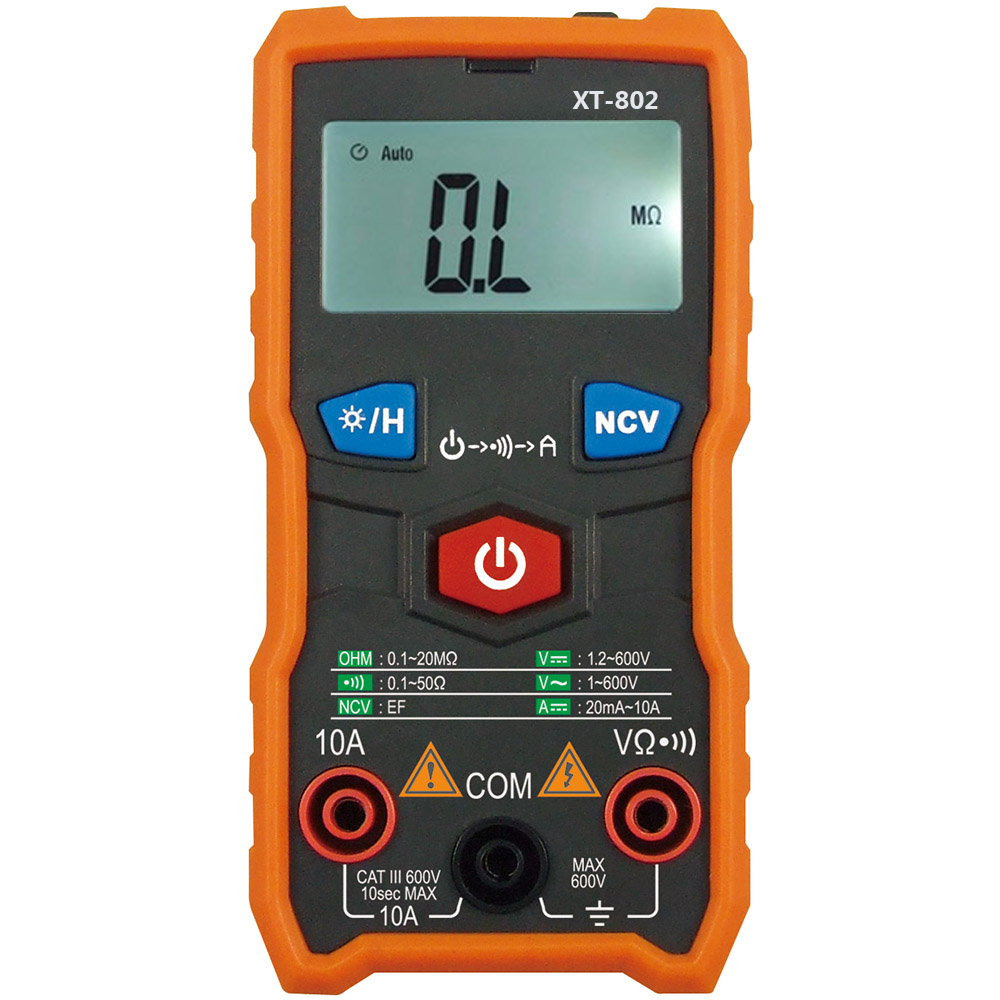
The XT802 prints its continuity range on the panel as 0.1 to 50 ohms, which is a fast band for long cable runs and for finding opens. When the actual resistance matters, the reading has to come from a resistance range rather than from the beep, and the same instrument covers 600 ohms to 60 megohms at plus or minus two percent. The fuse and breaker test guide covers the parallel-path trap that produces most false continuity passes.
The 10 A Jack and the mA Jack Are Not Interchangeable
Current is measured in series, which means the meter becomes part of the circuit and every milliamp passes through the instrument. That is why current inputs are fused where voltage inputs are not, and why the jack matters more than the range dial. A meter with a single 10 A jack measures from twenty milliamps upward; anything smaller is below its resolution. A meter that splits microamps and milliamps onto a separate jack can measure a standby current that the 10 A input cannot see at all.
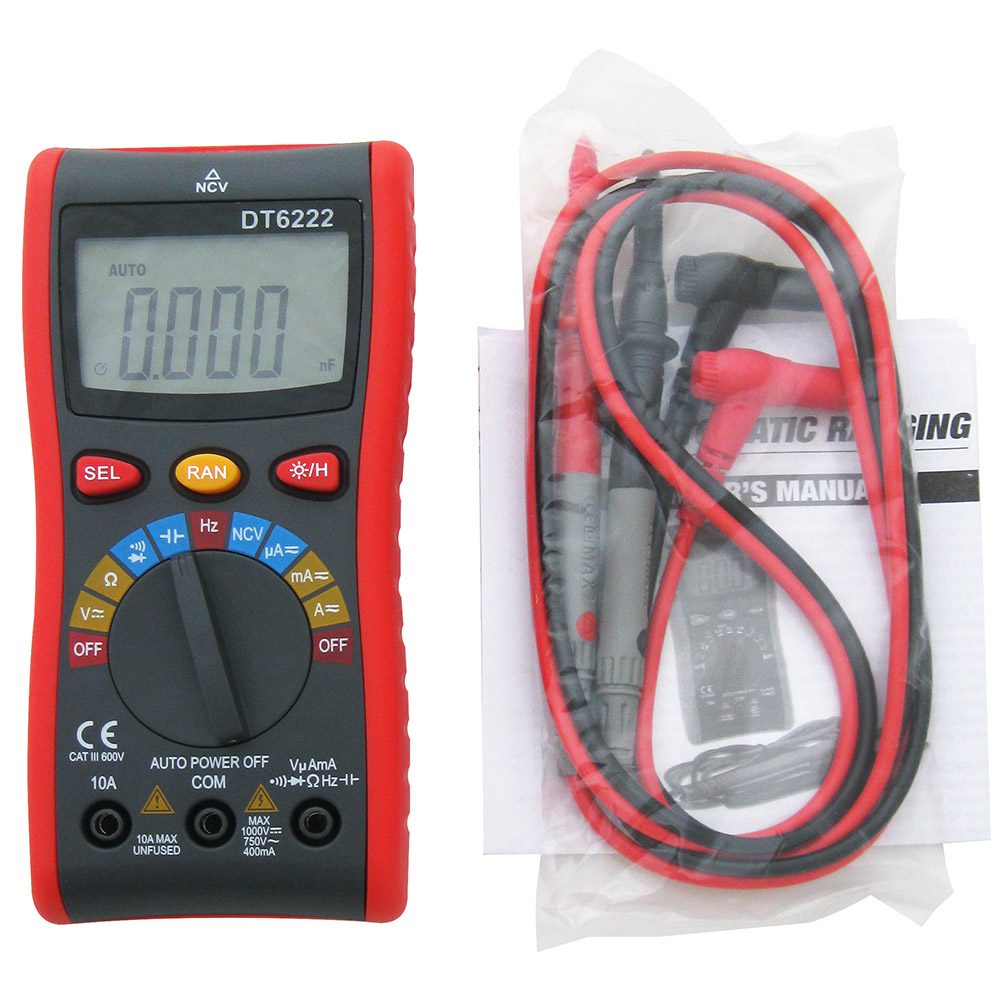
The DT6222 takes the second approach: the 10 A input is a separate unfused jack, and the microamp and milliamp ranges live on a fused jack rated to 400 milliamps across four ranges at plus or minus 1.4 percent. For fault-finding on control circuits, that split is the difference between being able to measure a few milliamps and not being able to measure them. The comparison of the two jack arrangements goes through the measurement consequences in detail.
The Resistance Range Is Where a Cheap Meter Shows Itself
Resistance is the measurement that reveals degradation, because it is the one that changes slowly and measurably before a fault becomes a failure. Watching a contact move from 0.05 ohms to 0.5 ohms across successive services tells you the joint is going, and it tells you before anything has failed. That only works if the meter resolves the low end of the range and holds its calibration, which is precisely where a low-cost build economises on the reference parts.
A useful test before buying is to short the two probes together and read the result. A good pair reads under 0.2 ohms, and the reading you get is the floor of everything the meter will measure afterwards. A meter whose own leads measure one ohm cannot tell a good joint from a marginal one at all, because both are inside its own error.
NCV Is a Second Opinion, Not a Verdict
Non-contact voltage detection is the feature most relied on and least understood. It responds to the electric field around a conductor, which means it can be triggered by a neighbouring live cable, by capacitive coupling through a wall, and by a conductor that is not connected to anything at all. Its value is that it is fast and does not require touching a terminal, and its danger is that a silent result is routinely read as proof of dead.
Treat it as a first pass that tells you where to put the probes, never as the measurement that authorises work. The basic multimeter procedure covers contact measurement, and the case where a tester beeps on a dead wire is covered separately in our explanation of that fault. Before any work on a circuit that is meant to be isolated, the confirmation has to come from a contact measurement on a known-good source followed by the conductor itself.
Choosing Between the XT802 and the DT6222 for Site Work
The two instruments share the same auto-ranging behaviour and the same non-contact detection function. Everything that separates them is on the specification sheet, and the table below lists only the rows where they actually differ.
| Specification | XT802 | DT6222 |
|---|---|---|
| Display counts | 6000 | 4000 |
| Current input | One 10 A jack covering 20 mA to 10 A, marked 10 s MAX | A separate 10 A jack, plus a fused microamp and milliamp jack covering 400 microamps to 400 milliamps at plus or minus 1.4 percent |
| Lowest current range | 20 milliamps | 400 microamps |
| Resistance | 600 ohms to 60 megohms, plus or minus 2.0 percent | 400 ohms to 40 megohms, plus or minus 1.2 percent |
| Capacitance | 4 nanofarads to 40 millifarads, plus or minus 10.8 percent | 4 nanofarads to 4 millifarads, plus or minus 3.5 percent |
Both instruments are auto-ranging, both have a non-contact detection function, and both are built for the same class of work. The choice comes down to two differences. The XT802 carries 6000 counts with a continuity band to 50 ohms and a single 10 A current input marked for ten-second duty, which suits installation work where the measurements are continuity, voltage and load current. The DT6222 carries 4000 counts but splits microamps and milliamps onto a fused jack with four ranges, adds frequency to 4 megahertz, a backlight and automatic power-off, which suits control and fault-finding work where small currents have to be measured.
Neither is the better instrument in the abstract. The mistake is buying the 6000-count meter for control panel diagnostics, where its current resolution never reaches the fault, or buying the milliamp-capable meter for installation work, where the extra ranges are never used and the lower count is the specification that shows. Our guide to using a multimeter covers the measurement procedures that apply to both.
Send Us the Work Your Customers Actually Do
If you are building a meter for a distributor’s electrical trade, send us the jobs your customers take on: domestic installation, industrial maintenance, control panel fault-finding or a mix. Tell us which functions are used weekly and which are never used, what the local trade expects to see on the panel, and the quantity for the first order. Our Wenzhou engineers reply within 24 hours with the platform that matches that mix, the specifications we can hold across a production run, and per-unit pricing against your numbers.