

The Carton and the Manual: What Sells a Meter Before It Is Switched On
A buyer standing in front of a pegboard decides with their eyes, and what they are looking at is a printed carton, not a circuit. The same 6000-count meter sold in a blister pack, a colour box and a neutral carton will find three different buyers at three different prices, and the difference is almost never the instrument. It is the format, the language on the back of the box and whether the pack can be hung, stacked or shelved. This is the part of a private label order that is cheapest to change and easiest to get wrong, and it is where most of the money between a landed cost and a shelf price is decided.
Cartons and manuals are also the two items that cannot be corrected after the fact without throwing away stock. A printed panel error costs the print run. A packaged error costs the print run, the packaging, the labour already spent packing it and the freight on goods that have to come back or be repacked in a warehouse. That asymmetry is the reason the packaging decision deserves to be made before the instrument is, not after.
Why the Box Carries More Decision Weight Than the Meter
Two meters with the same specification can be forty percent apart on a shelf and the buyer will usually take the one they can read. What they read first is the model number, then the count, then a small number of claims printed large enough to be seen from a metre away. The rest of the face is brand and colour. A pack that puts eight spec lines in six-point type has spent its front panel on information the buyer was never going to read there.
The back of the pack does different work. It carries the language set, the regulatory marking, the manufacturer identity and the battery information. In markets where the retail buyer reads the back before deciding to buy, the language of the back panel matters as much as the language of the manual, and it is the item most often forgotten when a buyer assembles artwork in a hurry.
The Five Carton Types and the Channel Each One Serves
The formats a factory can usually offer fall into a small set, and each exists because a specific channel asks for it. Choosing between them is a channel decision, not a taste decision.
| Format | Channel it serves | Where the cost sits | Usual mistake |
|---|---|---|---|
| Blister on a card | Pegboard and impulse retail | Tooling for the blister shape | Card printed before hang-hole position is fixed |
| Colour box | Counter and shelf where the buyer handles the pack | Board grade and print passes | Box sized to the meter, not to the accessories |
| Gift box | Premium positioning and kit presentation | Rigid board and interior fitment | Manual too thick for the fitment |
| PVC pouch | Tool bags, kits and contractor supply | Pouch material and sealing | Probes not protected in transit |
| Neutral carton | Distributor who labels in their own warehouse | Almost nothing above plain board | No inner protection once the retail pack is gone |
One model can sit in two of these formats at once for two different customers, and the factory can run them in the same production cycle as long as the packaging is settled before the run is scheduled. Which changes belong to packaging and which reach the hardware is set out in the private label breakdown. What cannot happen is a format change in the middle of a run, because the packing line is set up once.
Writing a Manual in a Language Nobody on the Line Reads
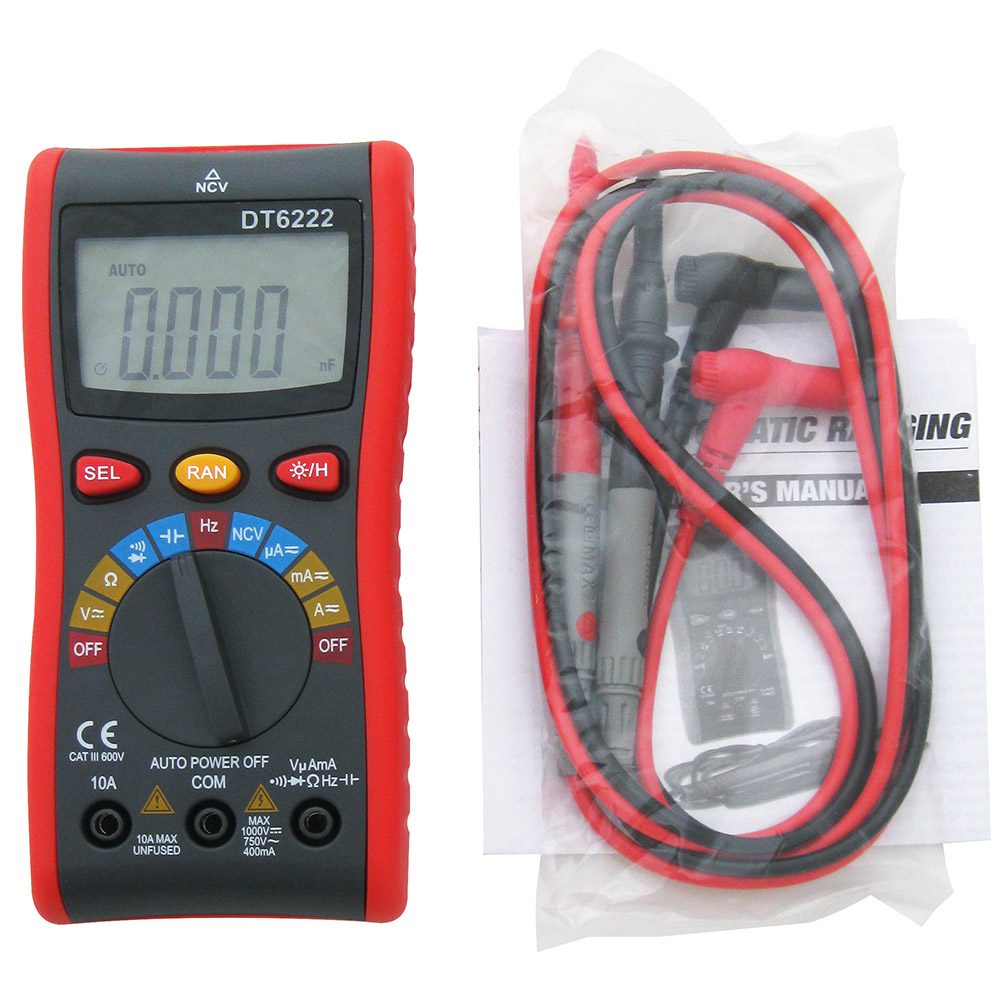
A multilingual manual is a single document with several language sections, not several documents. That structure keeps the page count down and lets the factory print one booklet for every market, which is why it is usually cheaper than buyers assume once the copy is signed off. The cost is in the revision, not the printing. Every range, every function key and every warning that appears in the manual is tied to a physical feature of the meter, so a change to the meter after the manual is printed invalidates the manual.
The practical consequence is that the manual copy has to come from the buyer’s market, not from the factory. Translation by an engineer produces a manual that is technically correct and reads like a service note. The buyer’s own distributor is usually the right person to write the retail-facing copy, and the factory’s job is to make sure the words match the instrument that will actually ship.
Right-to-left layouts are a separate problem. Arabic and Hebrew pages need the diagram captions, the numbered callouts and the page furniture mirrored, and a manual built as a single document with one mirrored section is far easier to check than one assembled from separate files. Ask for the RTL pages to be proofed as pages, not as text.
What Has to Be Printed on the Box and What Has to Be Left Off
The marking set is fixed by the destination market, and the factory’s job is to print exactly what the buyer’s compliance file says it may print. For a European order that usually means the CE mark and a RoHS statement, backed by the conformity documents the factory already holds. Anything beyond that set has to come from the buyer with a document behind it, because a marking printed without paperwork is a liability that travels with the goods.
Two habits prevent most problems here. The first is to keep the marking block as a separate layer in the artwork, so a market change does not force a redesign. The second is to print the manufacturer identity exactly as the compliance file records it, including the legal form of the company name, rather than a brand name that appears nowhere in the documentation.
Blister and Colour Box: The Cost That Never Appears on the Quote
A blister quote looks cheaper than a colour box quote and often is, per unit, on a single order. The difference appears later. Blister cards are cut to a specific shape, so the hang-hole position, the card dimensions and the thermoformed cavity are all locked together. Change the meter’s holster, or add a pair of probes to the kit, and the cavity no longer fits. A colour box absorbs the same change by getting slightly larger.
Colour boxes cost more in board and printing and less in flexibility. A buyer planning several model variations from one platform usually finds the colour box cheaper over a year, because one box size serves several models and the artwork changes without retooling. A buyer selling a single item through pegboard retail usually finds the blister cheaper, because the format itself is part of what the channel is buying.
Loading a Container When the Cartons Are Not Square
Container loading is a volume problem disguised as a price problem. Cartons that stack flush use nearly all of the available space. Cartons that are slightly too tall for a pallet tier, or that cannot be turned because the artwork prints on one face, leave a gap at the top of every pallet and that gap is paid for at the same rate as the goods. The whole calculation changes when a second SKU with different carton dimensions is loaded alongside the first.
This is worth raising while the packaging is still being designed rather than after the carton drawing is signed. A carton that is a few centimetres smaller on one axis can add several cartons per pallet, and the saving is larger than most of the line items buyers argue about on a quotation. The same logic applies to mixed-model containers, where the loading plan has to be built rather than assumed.
Approving Artwork From the Other Side of the World
Artwork approval is the one step in a packaging project that the buyer controls completely, and it is therefore the step that decides the timeline. The factory can print a proof within a day of receiving files. Nobody can print a proof of files that have not arrived, or that arrive in three versions across two email threads.
Send the artwork as one package: front panel, carton, manual and the language set for each market, with the market named on each file. Ask for the digital proof first and check it against the physical sample before releasing it to print. Our Wenzhou factory has run enough packaging programmes to know which questions come up at the proof stage, and the OEM and ODM page lists the formats in current use. If you are still deciding between a blister and a box, say so in the first message: that choice changes the cost sheet more than any other single line, and it is easier to answer before the artwork exists than after. The contact form reaches the engineering team directly.