

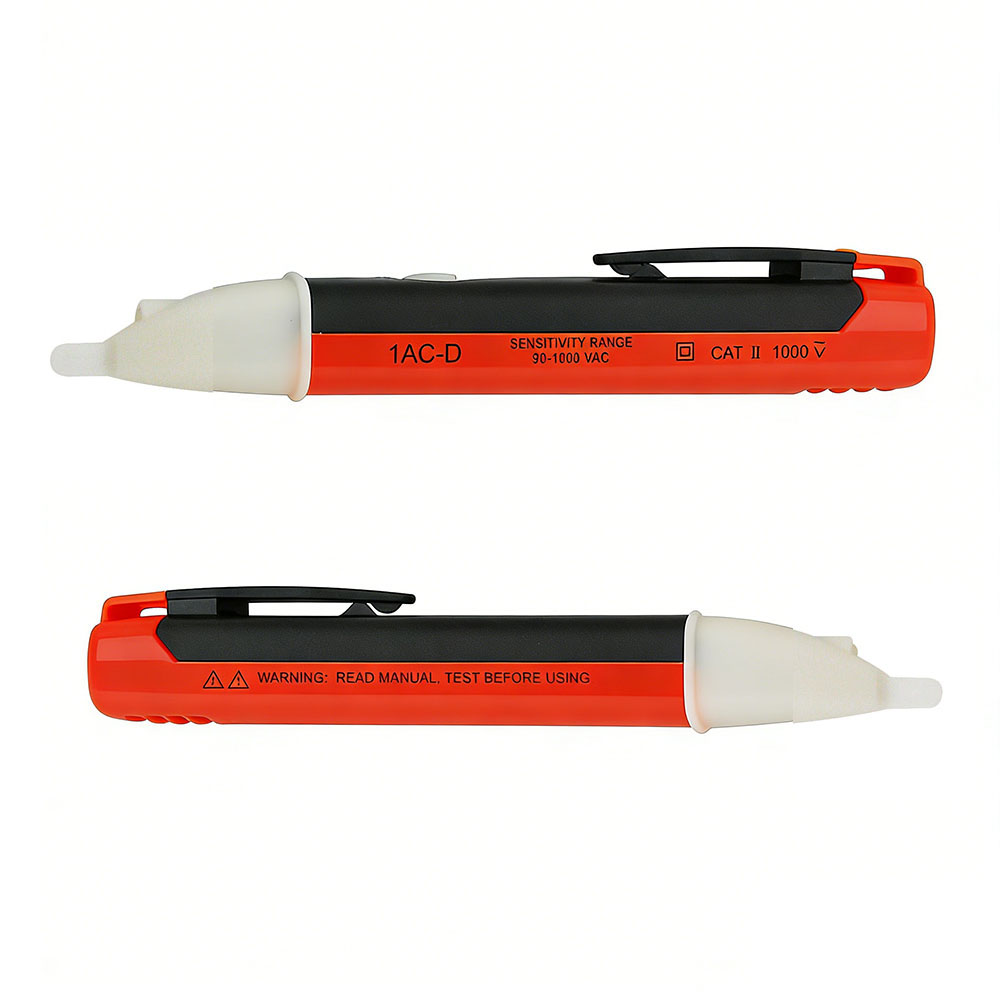
What the Number on a Voltage Tester Actually Means
A voltage tester that shows 220 V is not measuring 220 V in the way a multimeter measures it, and the difference is not a matter of accuracy. The number on a tester is derived from the strength of the electric field its tip is exposed to, converted through a calibration curve chosen by the manufacturer, and displayed as the nearest round value that the circuit is likely to be. It is a good answer to “is this live and roughly how live”, and a bad answer to “what is the voltage here”. Reading it as the second is the most common way a tester gets someone into trouble.
Wenzhou Zhengyuan Electronic Co., Ltd. builds the testers referred to below in its Wenzhou factory.
The Number Is an Indication, Not a Measurement
A multimeter measures voltage by drawing a defined current through a known resistance and reading the drop across it. The result is defined by the meter’s own components and is largely independent of how the user is standing, how far away the probe is, or what else is nearby. A tester works the other way round: it senses a field, and a field is a function of geometry. The same conductor produces a stronger signal when it is closer to the sensor, when it is longer, when it is bare rather than insulated, and when the person holding the pen is well coupled to the surroundings.
Everything the tester displays is therefore a signal strength mapped onto a voltage scale. Manufacturers calibrate that mapping so that a typical domestic circuit at a typical distance shows a familiar number, and for that case it works. Move the pen two centimetres away and the number falls. Hold it further still and the number falls again while the conductor has not changed at all. A pen with a readout is a genuinely useful instrument, but the number it shows is a property of the measurement arrangement as much as a property of the wire.
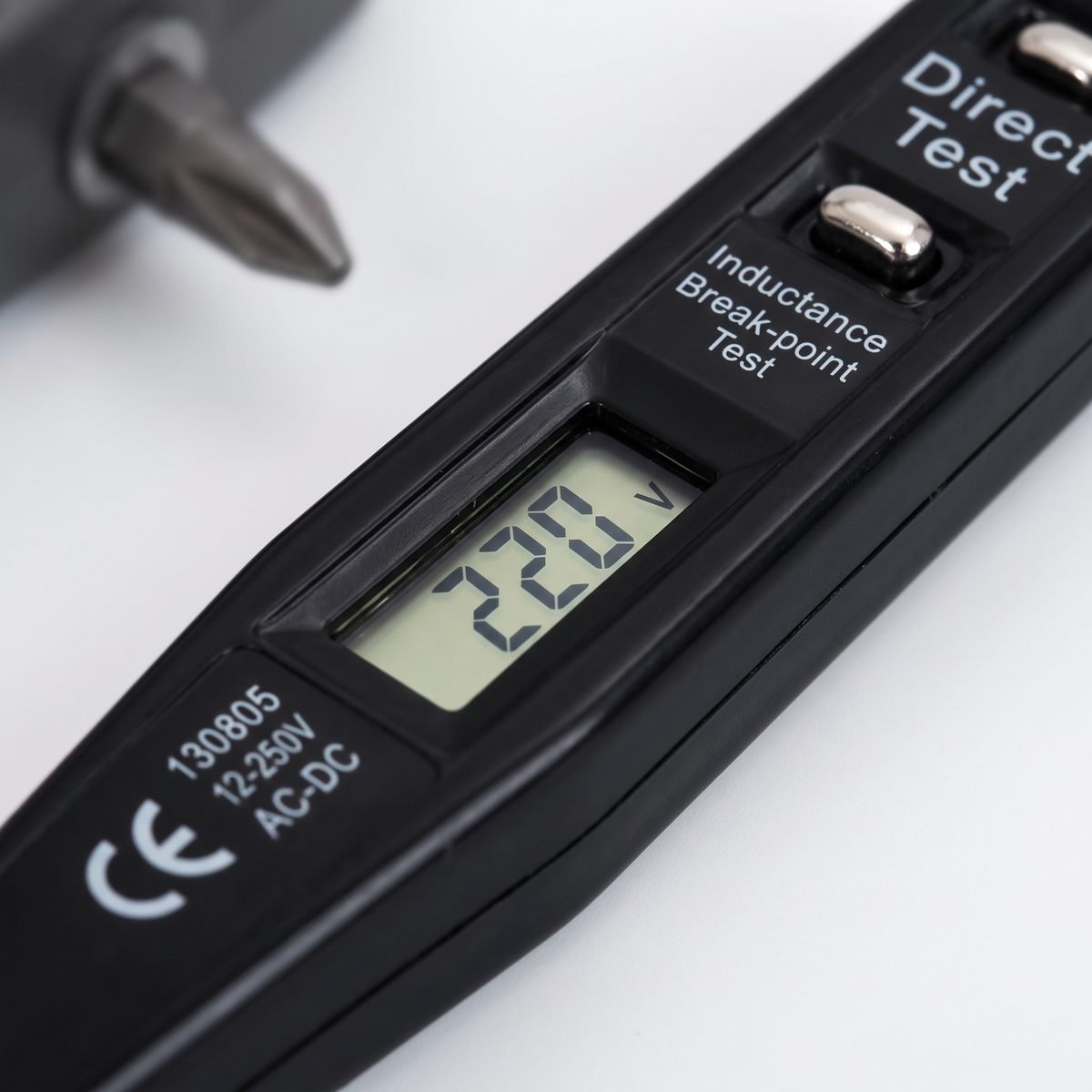
Direct Contact and Induction Are Two Different Methods
Most pens with a display offer both modes, usually on two separate buttons, and the two modes do not produce numbers of the same quality. In direct contact mode the tip touches the conductor, so the sensing element sees the conductor’s potential through a fixed path and the reading tracks the actual voltage reasonably well. In induction mode the tip never touches anything; it senses the field through insulation and air, and the reading depends on the gap, the insulation thickness, and the geometry of the cable.
That distinction decides which mode is worth trusting. A pen with a direct test button gives a number in contact mode that is close enough to compare against a multimeter, and a number in induction mode that should be read as “field present, roughly this strong”. A non-contact-only detector such as the M100 has no contact path at all, so every number it produces is a field-strength indication by construction. Neither mode is wrong, but they answer different questions.
Why the Same Wire Reads 220 V One Day and 130 V the Next
The wire has not changed. The arrangement has. A pen that read 220 V when you were standing on a concrete floor in shoes that had picked up moisture will read lower on a dry day, on an insulated ladder, or through a glove, because the return path from the pen through your body to the surroundings has become a worse conductor. The same effect appears when the cable is buried deeper in a wall, when a second cable runs alongside it and changes the local field, or when the pen is a few millimetres further from the conductor than it was.
This is also the mechanism behind a related problem: a tester can light up on a wire that is not connected to anything, because a disconnected conductor lying alongside a live one picks up a real voltage through capacitive coupling. In both cases the display is reporting something true about the field and something misleading about the circuit. The instrument is not lying; it is answering a question about the field when the user asked a question about the conductor.
Where the Number Is Genuinely Useful
The number earns its place in three situations. It sorts a live conductor from a neutral or earth in a box where several cables enter, because the difference between 220 and 3 is unmistakable even through a crude indication. It tells you whether a cable is carrying mains voltage or a low-voltage control signal, which decides which instrument you reach for next. And on a pen with a direct contact mode, it gives a rough sanity check that the circuit is at the voltage you expected rather than a stray or induced one.
What it does not do is replace the measurement. A reading of 218 on a pen and a reading of 231 on a multimeter are not a disagreement; they are two instruments describing the same circuit at different levels of precision. When the exact value matters — sizing a load, checking a charger, confirming a supply is within tolerance — the number to act on is the one from the meter, and the pen’s job is to tell you it is safe to connect the meter.

Reading the Display: Five Cases
These are the five readings that come up most often, and what each one is actually telling you about the instrument and the circuit.
| What the display shows | What the tester is doing | What you can conclude |
|---|---|---|
| 220 V or 230 V in direct contact mode | The tip is touching a live conductor and the internal divider is reading across a fixed path | Mains is present and the pen is working; the exact value still belongs to a multimeter |
| 110 V to 130 V in direct contact mode | The same path, but the circuit is at a lower nominal voltage or the reading is loaded by the pen’s own input | Treat the conductor as live; check the nominal supply before assuming anything about the value |
| A number that flickers or jumps | The field at the tip is marginal, or the return path through the user is unstable | The circuit may be live; the number is not usable as a value |
| No number, but the induction indicator lights | Field detected through insulation or air, below the threshold at which the display shows a value | Treat the conductor as live; the pen cannot tell you how live |
| Blank, dashes, or OL on a conductor you know is live | The pen has failed, the cell is flat, or the tip is not making contact | Stop: this is a failed instrument, not a dead circuit |
Where the Number Will Mislead You
The most expensive mistake is treating a low number as evidence that a circuit is safe. A pen that shows 12 V on a conductor that should be at 230 V has not established that the conductor is at 12 V; it has established that the field at its tip is weak. That can mean a dead circuit, a live circuit that is far away, a live circuit behind thick insulation, or a user standing on an insulated surface. The four cases are indistinguishable from the display, and only one of them is safe.
The second mistake is comparing a pen’s number with a multimeter’s number and treating the gap as an error in one of them. The two instruments are answering at different levels of precision and through different physical paths, so the gap is expected. The comparison is still worth making, but only for the question it can settle: do both instruments agree that the conductor is live? That is the same question a tester versus multimeter comparison comes down to, and it is the question the pen was designed for.
A Number or a Beep: Which One to Carry
A beep-only detector is faster, cheaper, and impossible to misread as a measurement. A pen with a display costs more and gives you a number you have to know how to interpret. For daily work where the question is always “is this safe to touch”, the beep does the job and the number adds a decision the user has to make correctly every time. For sorting circuits, distinguishing mains from control voltage, and documenting what was found, the number is worth having and worth explaining.
The practical answer for most trades is a pen whose display supports the work rather than replacing it. The 6885-48 is built around that idea: a number for sorting and a clear indication for safety, with the user expected to know which one they are relying on. Whichever pen is in the pocket, the rule does not change — the number tells you what the field looks like, and only a second instrument tells you what the circuit is.