

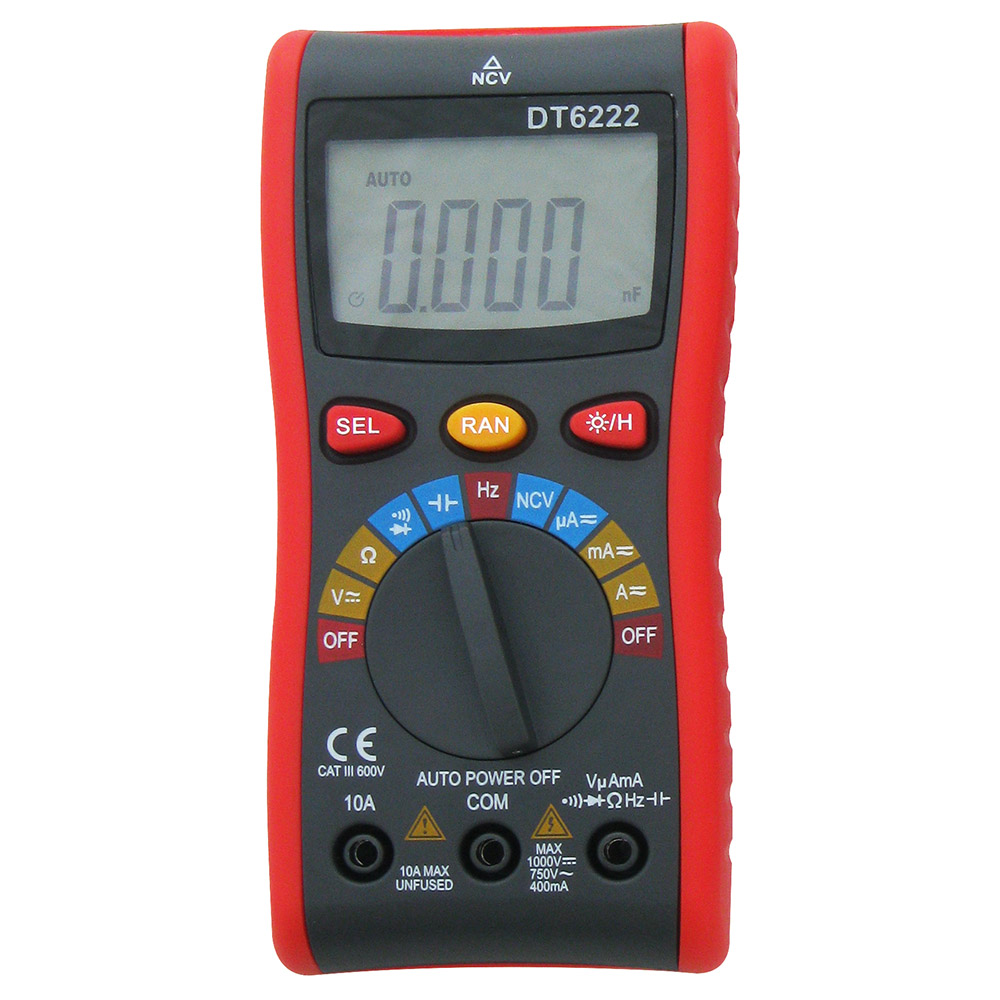
A failed capacitor does not announce itself. It can go short, in which case the plates have bridged and a resistance check reads a dead short. Or it can dry out and lose capacitance while still measuring as a healthy open circuit, which is the failure that takes motors, compressors and pumps off the line and the one that gets misdiagnosed as a bad winding, a bad contactor or a supply problem. A resistance check catches the first. Only a capacitance reading catches the second, and the DT6222 carries that range on the same dial as volts, ohms and frequency, at 4 nF to 4 mF with a ±3.5% specification.
This guide is written for the person holding the probes rather than the person reading a catalogue, and every figure in it comes from our production specification sheets. Wenzhou Zhengyuan Electronic Co., Ltd. builds both of the meters named below in its Wenzhou factory.
Discharge the Capacitor Before You Measure It
The first step is not a measurement. A capacitor that was in a live circuit a minute ago can still hold its charge, and the larger electrolytics in motor and compressor circuits can hold it for minutes after the supply is isolated. Before the probes go anywhere near the terminals, isolate the equipment and discharge the capacitor by connecting its two terminals together through a resistor, holding the connection until the reading on a voltmeter across those terminals falls to zero. A purpose-made discharge tool does the same job. If the equipment is not something you are trained and authorised to work on, the correct move is not to test it.
Once the terminals read zero volts, the capacitor is safe to handle and the two tests below can be run in either order. The basic multimeter procedure covers the meter handling itself if you need it, but the sequence that matters here is discharge first, measure second, every time.
Short and Open: What a Resistance Check Finds
Set the meter to its highest resistance range and put the probes across the capacitor with the component isolated from the circuit. A capacitor in good condition will not sit on a single number. The meter’s own test current charges the capacitor, so the display rises steadily toward the open-circuit reading and eventually settles at or near infinity — or reads OL on an auto-ranging meter. That rising movement is the signature of a healthy component, and it is worth watching for rather than reading a single value.
A capacitor that is shorted will hold at or near zero ohms and stay there. That is a definite failure and the component comes out of the circuit. A capacitor that reads infinity immediately, with no rising movement at all, is open — the internal connection has broken and the component is equally dead. What a resistance check cannot tell you is whether a capacitor that passed it still has the capacitance it is supposed to have, which is the gap the next section closes.
What the Capacitance Range Actually Measures
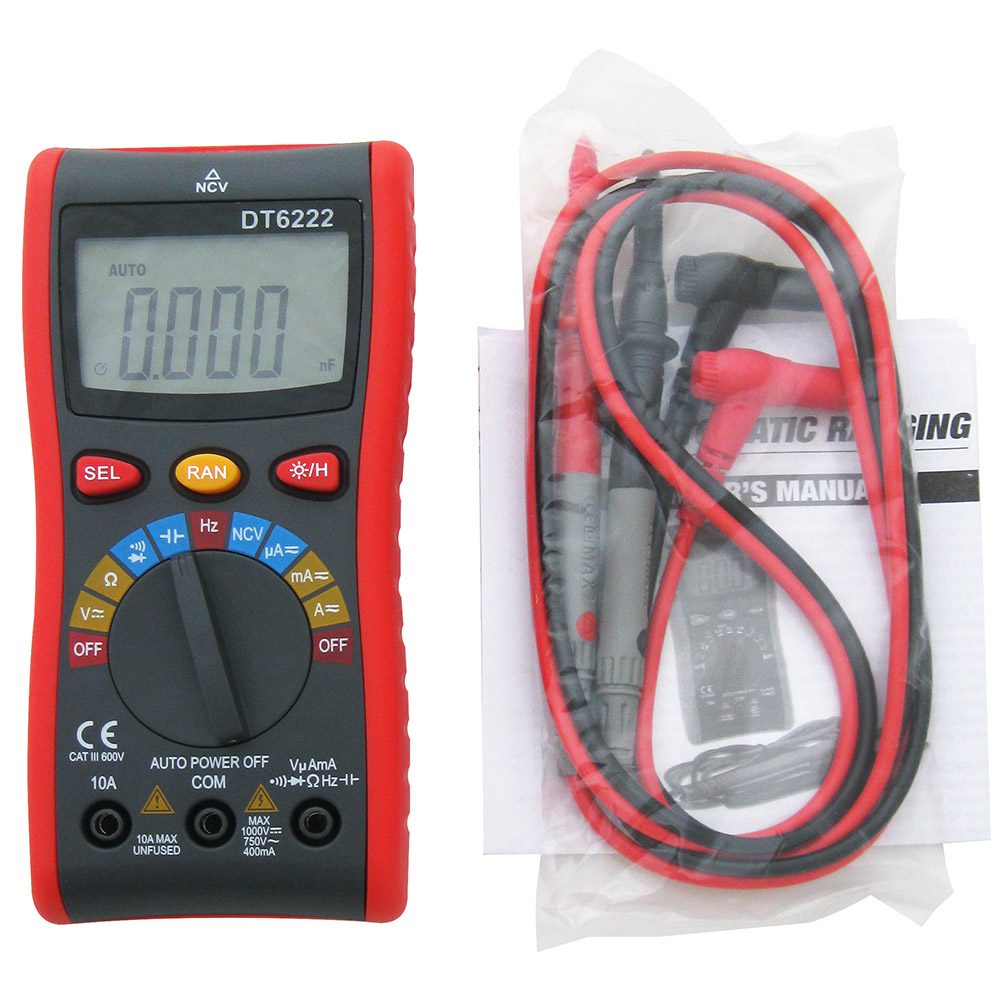
Switch to the capacitance range and the meter applies its own AC signal to the component and reports the resulting capacitance directly in farads. On the DT6222 the range runs from 4 nF to 4 mF, which covers signal capacitors, the small film types used in snubber circuits and the run and start capacitors found on single-phase motors. The XT802 reaches further, from 4 nF to 40 mF, on a 6000-count display that resolves smaller steps within each decade.
Two practical points decide whether the number you get is usable. The first is that the capacitor must be out of circuit. A capacitor still connected in parallel with other components will be measured along with them, and the reading will be meaningless. The second is that capacitance measurement is slow on the low ranges — the meter has to charge the component to take its measurement, so a reading that takes a second or two to settle is normal and not a fault in the instrument.
Reading the Number: Judging a Capacitor Against Its Tolerance
The reading itself is only useful against a reference. A run capacitor is marked with its nominal value and a tolerance, commonly ±5% or ±10%, and the question is whether the measured value falls inside that band. A 30 µF run capacitor marked ±5% should read between 28.5 and 31.5 µF. A capacitor that has lost a third of its value will still show continuity, will still read as an open circuit on the resistance test, and will still be the reason the motor will not start under load.
This is where the accuracy of the meter’s capacitance range stops being a footnote. The DT6222 specifies ±3.5% on capacitance, which is tight enough to make the judgement above directly: on a 30 µF component, a metre-level tolerance of about ±1 µF sits well inside the ±5% acceptance band, so the meter is not the limiting factor. The XT802 specifies ±10.8% across its much wider range, which is the honest trade for covering four decades up to 40 mF — usable for confirming that a capacitor is in the right order of magnitude and for finding one that has lost most of its value, but not the instrument to certify a component against a ±5% band. Reading the manufacturer’s tolerance on both the component and the meter, rather than assuming the meter is perfect, is what separates a diagnosis from a guess.
Run, Start and Motor Capacitors in the Field
Three capacitor types account for most of the work. Run capacitors stay in circuit while the motor runs and shift the phase of the auxiliary winding; they are the ones that fail slowly and cause a motor to run hot, draw more current than it should and eventually trip. Start capacitors are in circuit only during the first fraction of a second and fail abruptly, which presents as a motor that hums and will not turn. The third group is the suppression and snubber capacitors on contactors and drives, which fail short and take a fuse with them.
Each failure presents as something else first, which is why the capacitance range earns its place on a service meter. The HVAC guide covers the measurement set that motor-and-compressor work runs on, including the temperature checks that usually accompany a capacitor diagnosis, and the dial symbols guide is the reference for finding the capacitance position on an unfamiliar instrument.
Why Capacitance Accuracy Varies So Much Between Meters
The 3.5% and 10.8% figures above are not arbitrary. A meter covers a decade of capacitance with a single internal reference, so extending the top of the range from 4 mF to 40 mF — as the XT802 does — buys coverage at the cost of resolution and tolerance across the whole band. Manufacturers who quote a single capacitance accuracy across a four-decade range are either quoting a best-case figure or measuring over a narrower band than the range suggests. It is worth reading the specification table rather than the headline number before you buy a meter for capacitor work: the useful question is not how wide the range is but how tight the accuracy is at the values you actually measure, which for single-phase motor work means the 1 µF to 100 µF band rather than the bottom or the top of the range.
That is also why a bench LCR meter and a hand-held multimeter are not in competition. The LCR meter measures one component precisely on a bench; the hand-held meter measures the same component in the plant room, and the tolerance you give up is the price of it being in your hand at all.
Test the Meters in Your Own Workshop
Before you commit to a range for capacitor work, order a sample of each and measure a set of known components — a 10 µF, a 30 µF and a 100 µF run capacitor, plus a film capacitor in the nanofarad range — on both meters and against whatever you stock today. The difference between ±3.5% and ±10.8% shows up immediately on the 10 µF and 30 µF components, and that is the comparison your trade customers will eventually make themselves. Then send us the values you measured, the capacitor work your customers actually bring through the door and the quantities you are planning. Our Wenzhou engineers reply within 24 hours, confirm whether the DT6222 or the XT802 suits the line you are building, and quote per-unit pricing once we have your numbers.