


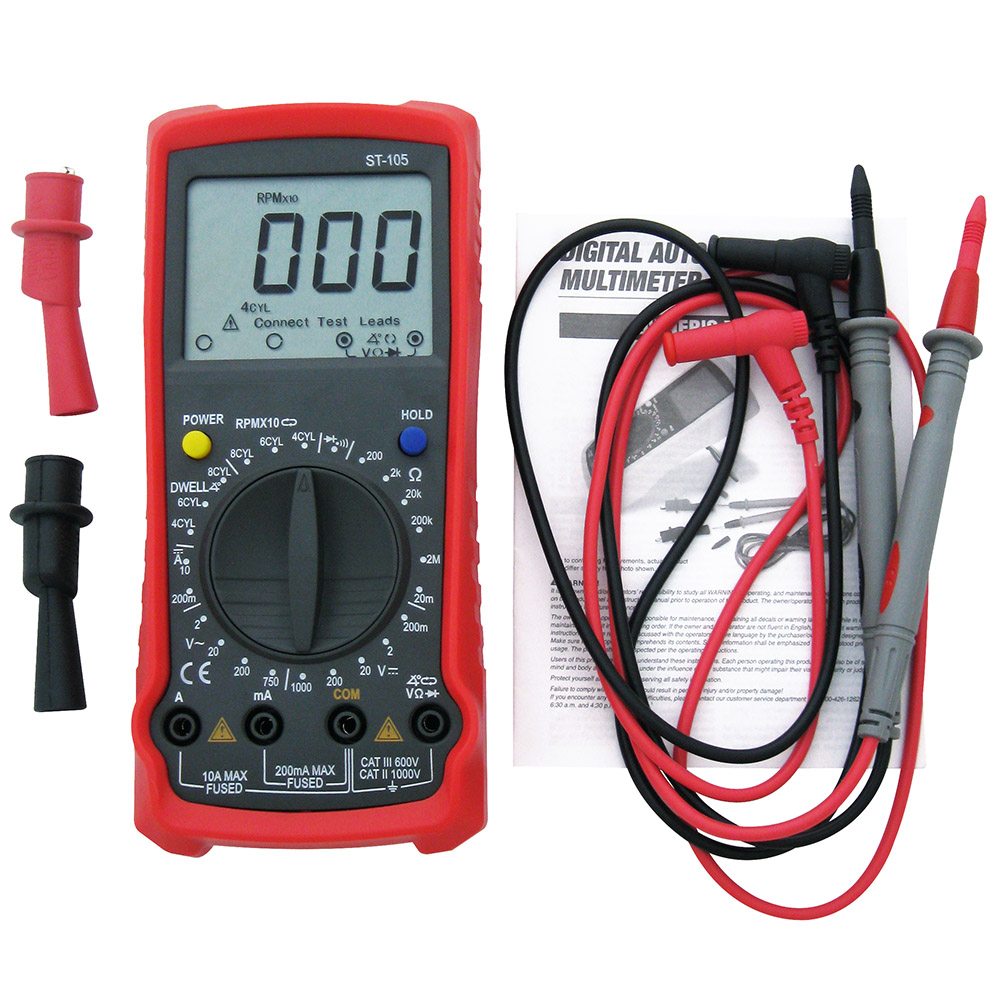
Most multimeters read voltage, resistance and current, and stop there. The ST105 adds two scales the others leave out: engine speed in RPM and distributor dwell angle, each selectable for 4-, 6- or 8-cylinder engines. For a workshop that still tunes distributor ignition, or for a supplier selling to one, that pair of scales is the reason this meter exists.
We assemble the ST105 at our Wenzhou factory, and the numbers below are from our own production sheet. This guide is for the auto-electric shop and classic-car restorer deciding whether the ST105 earns a place beside their main meter, and for the distributor who wants an automotive SKU that is not just another 1999-count multimeter with a car sticker.
What Dwell Angle Is, and Why It Still Matters
In a distributor with mechanical breaker points, the points open and close once per cylinder firing. Dwell angle is how long the points stay closed, measured in degrees of distributor rotation. Too little dwell and the coil does not saturate, which weakens the spark; too much dwell and the points overheat and erode early. Setting dwell to the manufacturer’s figure is a normal part of a tune-up on any points-and-condenser system.
That setting needs a meter that reads the ignition waveform. The ST105 measures dwell angle for 4-, 6- and 8-cylinder settings at ±3.0%, which is the scale a mechanic reads against the factory spec in the service manual. The same dial position gives you engine RPM from the same signal, so you can set an idle speed and then confirm dwell without switching tools.
What Else the ST105 Reads
Around those two automotive scales it is a normal service multimeter. DC voltage runs from 200 mV to 1000 V at ±1.5% and AC voltage from 2 V to 750 V at ±1.8%. Resistance reads from 200 Ω to 20 MΩ at ±5.0%, and capacitance from 40 nF to 400 µF, which lets you check the condenser and small capacitors in the same bay where you set the points. Data hold, a continuity buzzer, a diode test and overload protection are all on the dial. The display is a 1999-count LCD, and the meter runs on one 9 V 6F22 battery.
Be clear about the limits. The current ranges are DC only, from 200 mA to 10 A, and there is no backlight, so this is a daylight and bench meter rather than a night-time dash tool. It is built for the distributor-era garage and the classroom, not for chasing intermittent faults on a modern engine-management bus.
Where It Belongs in Your Line
The ST105 is not a replacement for the general-purpose meters a shop already owns. It is the second meter you reach for when the first one has told you the ignition is the suspect. If the work is vintage cars, classic motorcycles, or teaching ignition theory in an auto-electronics course, the tach and dwell scales earn their place; if the whole fleet is modern electronic ignition, they will sit unused.
For a supplier, that makes the ST105 a specialist line rather than a volume line, and it pairs naturally with the rest of an automotive test range. A shop that stocks the meters used for battery and charging-system checks is the same shop that still sees points cars on the lift, so the ST105 closes a gap the general meters leave open. Every unit passes the same function check before it ships, under CE and RoHS compliance and the 12-month warranty that covers the range.
Test It Before You Rely on It
Dwell and RPM readings depend on a clean connection to the ignition signal, and the exact hook-up depends on whether you are working on positive- or negative-ground and on your particular distributor. The printed manual in the box shows the connection for each cylinder setting. If you are comparing the ST105 against a dedicated dwell tachometer, run both on the same engine and confirm the numbers track before you make it your tuning meter.
Try the ST105 on a Points Car Before You Stock It
Order a sample, clip it onto a distributor car you can set points on, and confirm the dwell and RPM scales read against your existing tach. Then tell us what you found and what your mix looks like: how much of the work is 4-, 6- or 8-cylinder, whether points-and-condenser cars still cross your bench, and the quantity you would start with. Our Wenzhou engineers reply within 24 hours, confirm the ST105 fits that mix, or point you to a general-purpose meter when dwell and tach are not part of your job, and quote per-unit pricing once we have your numbers.