

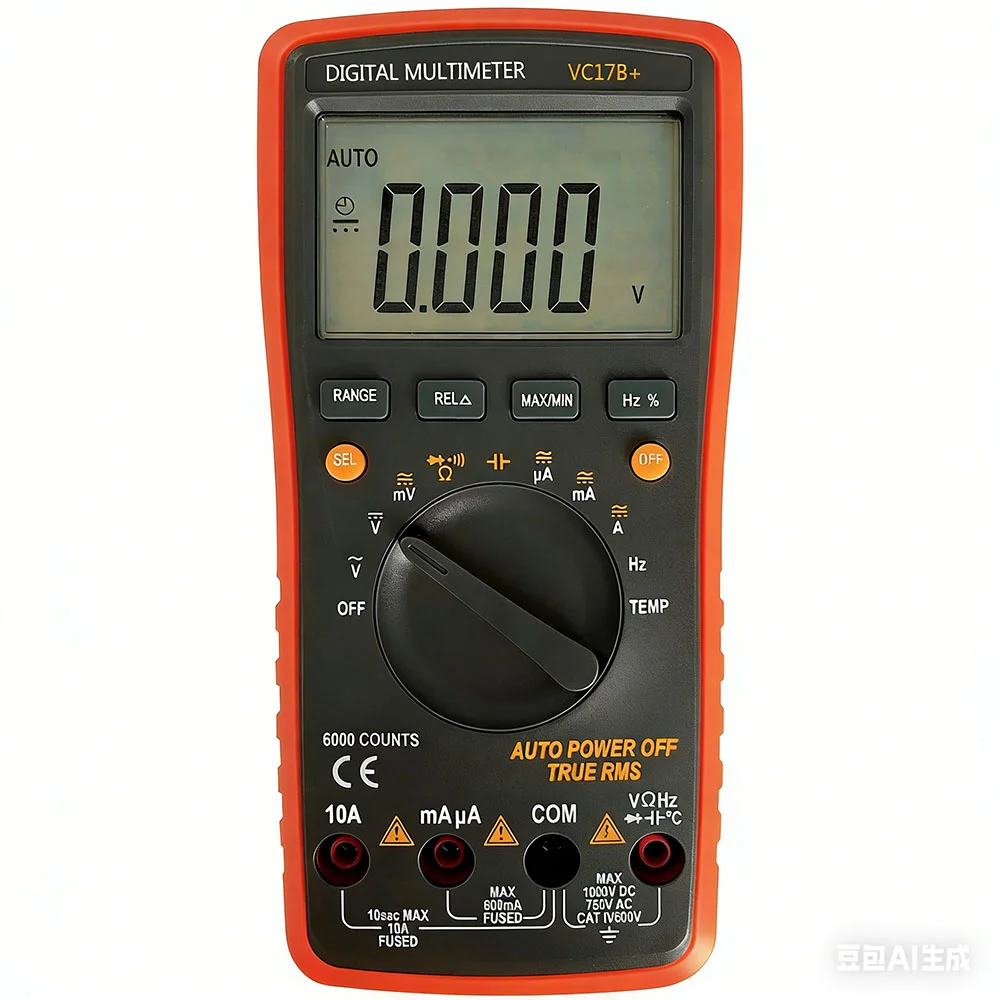
True RMS vs Average-Responding: Which Meter a Job Actually Needs
An average-responding meter measures the rectified average of a waveform and then multiplies by 1.11 to display what a sine wave would be. A true RMS meter squares the signal, averages the square, and takes the square root. For a clean sine wave the two answers are identical. For anything that is not a clean sine wave the first method is wrong by an amount that depends on the shape of the waveform, and the reading gives no sign that it has gone wrong.
At our Wenzhou factory both kinds leave the same bench, and the question that decides between them is almost never “which is more accurate”. It is “what will be plugged into it”. A meter measuring a heater element does not need True RMS and never will. A meter measuring the output of a variable frequency drive needs it, and needs a crest factor allowance on top that the brochure rarely prints.
What the 1.11 Factor Assumes
The number 1.11 is the ratio between the RMS value and the rectified average of a sine wave. It is a property of that one shape and nothing else. An average-responding instrument rectifies the incoming signal, smooths it, and scales the smoothed value by 1.11 so that a sine wave reads correctly. The circuit does not know what shape it is receiving. It applies the same constant to everything.
That is the whole design, and it is a good design for the job it was built for. Mains voltage in most of the world is close enough to a sine that the assumption holds within the tolerance of the meter. Where it fails, it fails quietly: the display shows a stable number, the number looks reasonable, and nothing about it suggests the waveform.
Where the Two Meters Disagree
The size of the disagreement depends on the crest factor, which is the peak value divided by the RMS value. A sine has a crest factor of 1.41. A square wave has 1.0, and an average-responding meter reads it about 11 percent high. A half-wave rectified sine has 2.0 and reads about 30 percent low. A phase-angle controlled dimmer output changes its crest factor as the firing angle moves, so the error moves with the dial.
| Waveform | Crest factor | Average-responding meter | True RMS meter |
|---|---|---|---|
| Clean sine | 1.41 | Correct | Correct |
| Square | 1.00 | About 11 percent high | Correct |
| Half-wave rectified sine | 2.00 | About 30 percent low | Correct if the crest factor is within the meter rating |
| Phase-angle controlled output | 2 to 4 | Low, and shifts with firing angle | Correct if the crest factor is within the meter rating |
| PWM or VFD output | 2 to 3 plus high-frequency content | Unreliable | Correct only within the meter bandwidth |
Read the last column carefully. True RMS is not a blanket guarantee. It removes the waveform-shape error and leaves two other limits in place: the crest factor headroom of the converter, and the bandwidth of the meter. A True RMS meter that stops at 1 kHz is still wrong on a 10 kHz switching waveform, and the display will not tell you so.
How to Tell From a Datasheet Whether It Is Really True RMS
The words “True RMS” on a front panel are a marketing statement. The specification table is the evidence. Look for the AC accuracy being given as a percentage of reading rather than a percentage of full scale, because average-responding instruments are commonly specified against full scale while RMS converters are specified against reading. Look for a crest factor figure, usually printed as something like “AC crest factor up to 3 at full scale”. Look for an AC bandwidth figure in the AC voltage row.
If all three are present, the instrument is describing a real RMS converter with stated limits. If the AC row gives only a percentage and a count term with no crest factor and no bandwidth, the meter may still be a genuine True RMS design, but the datasheet has not given you the number that decides whether it will work on your load.
Crest Factor Is the Limit Nobody Quotes
Every RMS converter has an input range it can handle, and a waveform with a high peak can clip even when its RMS value is comfortably inside the selected range. A signal with a crest factor of 4 on the 200 V range peaks at four times the RMS, so a reading of 50 V RMS peaks at 200 V and sits right at the top of the range. Push the reading higher and the peaks clip, the RMS answer falls, and the display shows a lower number than the truth.
This is why the correct range for an RMS measurement is often one step higher than the correct range for a sine. It is also why two True RMS meters can disagree on the same distorted load while both being within their published specifications.
Loads That Make the Difference Show Up
Three kinds of load separate the two designs in practice. The first is anything fed through a semiconductor switch: dimmers, speed controllers, soft starters, and the output of a variable frequency drive. The second is equipment with a switch-mode power supply drawing current in short pulses rather than continuously, which includes most modern electronics and most LED lighting. The third is anything where the current is deliberately chopped, such as a phase-fired heater control.
A resistive heater on a plain contactor is not on the list. Neither is an incandescent lamp, nor a transformer feeding a linear load. If the entire workload is that kind of equipment, an average-responding meter is the correct purchase and paying for a converter adds nothing to any reading the user will take.
What It Costs to Add True RMS to an Order
The cost difference is not in the display and not in the case. It sits in the analogue front end, where an average-responding instrument uses a rectifier and a scaling constant while a True RMS instrument needs a converter that squares the input over its bandwidth. That converter is the part that has to be specified, sourced consistently, and calibrated against a reference, and it is where the specification and the price difference both come from.
For a buyer, this means the question is not “add True RMS or not” but “add it to which ranges”. Putting a converter on the AC voltage function and leaving the current ranges average-responding is common and is a defensible build, provided the model number and the datasheet say so plainly. What is not defensible is a front panel that says True RMS while the datasheet lists an AC current accuracy expressed against full scale with no crest factor.
Deciding Per Range, Not Per Meter
The useful way to settle the question is to write down, per function, what waveform the user will actually see. Voltage at a wall outlet is usually a sine. Current through a motor on a drive is not. A meter that is correct on one and wrong on the other is a perfectly reasonable product, as long as the buyer knows which is which before the carton is printed.
Bring that list to the sample stage. Tell our engineers the functions, the expected waveform on each, and the crest factor if it is known, and the requirement can be matched to a build rather than argued about after delivery. Units from our Wenzhou factory are measured against a reference before shipment, and the waveform limits of the build go on the datasheet with the accuracy figures, not in a footnote.