

What the Counts on a Multimeter Display Actually Change
A 6000-count meter does not measure more accurately than a 1999-count meter in any general sense. The count figure describes how finely the display divides whatever range the instrument is sitting on. A 1999-count meter on its 2 V range moves in steps of 1 mV. A 6000-count meter on its 6 V range also moves in steps of 1 mV. Put them both on a 5.5 V reading and the 1999-count instrument has to climb to its 20 V range, where the step becomes 10 mV, while the 6000-count instrument stays where it is.
That example is the whole argument, and it is why the counts number is worth more than a line on a brochure. It does not tell you the meter is better. It tells you where the meter runs out of headroom before it runs out of range, and that point is different for every reading a technician takes.
We build both classes in Wenzhou, the 1999-count DT9205A+ and the 6000-count DM101, and the question that decides between them is almost never the one a buyer asks first. The useful question is not which instrument has more counts. It is which reading the user has to resolve, on which range, and whether that reading sits near the top of a range or just above the bottom of the next one.
Counts Define the Size of One Step
The display can show a fixed number of different values on each range, and the count figure is that number. A 1999-count instrument divides a range into about two thousand steps, so the step size is the full scale divided by two thousand. A 6000-count instrument divides the same span into six thousand steps, so each step is roughly a third as large.
That is the entire mechanism. There is no hidden processing and no interpolation. The converter produces a number, the firmware rounds it to the nearest display step, and the step size is set by the count class and the range. Two meters with the same counts and the same range have exactly the same resolution, whatever their price difference suggests.
Resolution Is Not the Same Thing as Accuracy
A finer step lets you see smaller changes. It does not promise that the absolute value is closer to the truth. This is the distinction that causes most of the confusion in purchase enquiries, and it has a longer treatment in our guide to reading a percentage plus counts specification, because the count term in that specification is a different count from the one in the model name.
A 6000-count meter with a quoted tolerance of ±(1% + 3) can be less accurate than a 1999-count meter quoted at ±(0.5% + 2), even though it resolves ten times more finely at some readings. The count in the accuracy row is an error budget. The count in the model name is a display capability. They share a word and nothing else.
Same Reading, Two Meters, Different Steps
The table below takes five readings a technician might actually need to resolve and puts the two classes side by side, using the range each instrument would select for that reading. The steps come from the range spans, not from a marketing sheet: the DT9205A+ offers 200 mV, 2 V, 20 V, 200 V and 1000 V ranges, and the DM101 offers 600 mV, 6 V, 60 V, 600 V and 1000 V.
| Reading you need to resolve | 1999-count meter: range and step | 6000-count meter: range and step |
|---|---|---|
| 0.15 V | 200 mV range, 0.1 mV per step | 600 mV range, 0.1 mV per step |
| 1.5 V | 2 V range, 1 mV per step | 6 V range, 1 mV per step |
| 5.5 V | 20 V range, 10 mV per step | 6 V range, 1 mV per step |
| 55 V | 200 V range, 100 mV per step | 60 V range, 10 mV per step |
| 420 V | 1000 V range, 1 V per step | 600 V range, 100 mV per step |
Three rows of that table are identical and two are not. The difference appears exactly where a reading crosses the top of a 1999-count range: above 2 V, above 20 V, and above 200 V. Below those points the two classes resolve the same, and the extra counts buy nothing at all.
Why 6000 Counts Sits at the Range Boundary
The five ranges on a 6000-count meter are set so that each one covers a decade of readings with room to spare: 600 mV, 6 V, 60 V, 600 V, 1000 V. A reading of 5.5 V sits comfortably inside the 6 V range, and a reading of 55 V sits inside the 60 V range. That layout is not an accident. It is chosen so that the common readings in low voltage work, which cluster around 5 V, 12 V, 24 V and 48 V, each land in the middle or top of a range rather than just above the bottom of the next one.
A 1999-count meter uses the older decade layout of 200 mV, 2 V, 20 V, 200 V and 1000 V, which suits readings that cluster around 1.5 V, 12 V, 120 V and 230 V. Both layouts are rational. They are simply tuned for different sets of numbers, and the tuning matters more than the headline count figure when a technician works on one kind of circuit all day.
Where the Extra Digit Earns Its Cost
Testing a 12 V battery is the clearest case. A 1999-count meter on the 20 V range resolves 10 mV, and that is enough to see a battery fall from 12.60 V to 12.45 V as it ages. The step is coarse but the trend is visible. The same reading on a 6000-count meter on the 6 V range resolves 1 mV, and now the change from 12.60 to 12.55 V is a visible five-step movement rather than a rounding decision.
Measuring a shunt at a few millivolts is the other case. On the 200 mV range both classes resolve 0.1 mV, so the extra counts do nothing and the accuracy row decides the purchase. This is the situation where a buyer who pays for the higher count class gets no benefit, and where the honest answer is that the cheaper instrument measures the same.
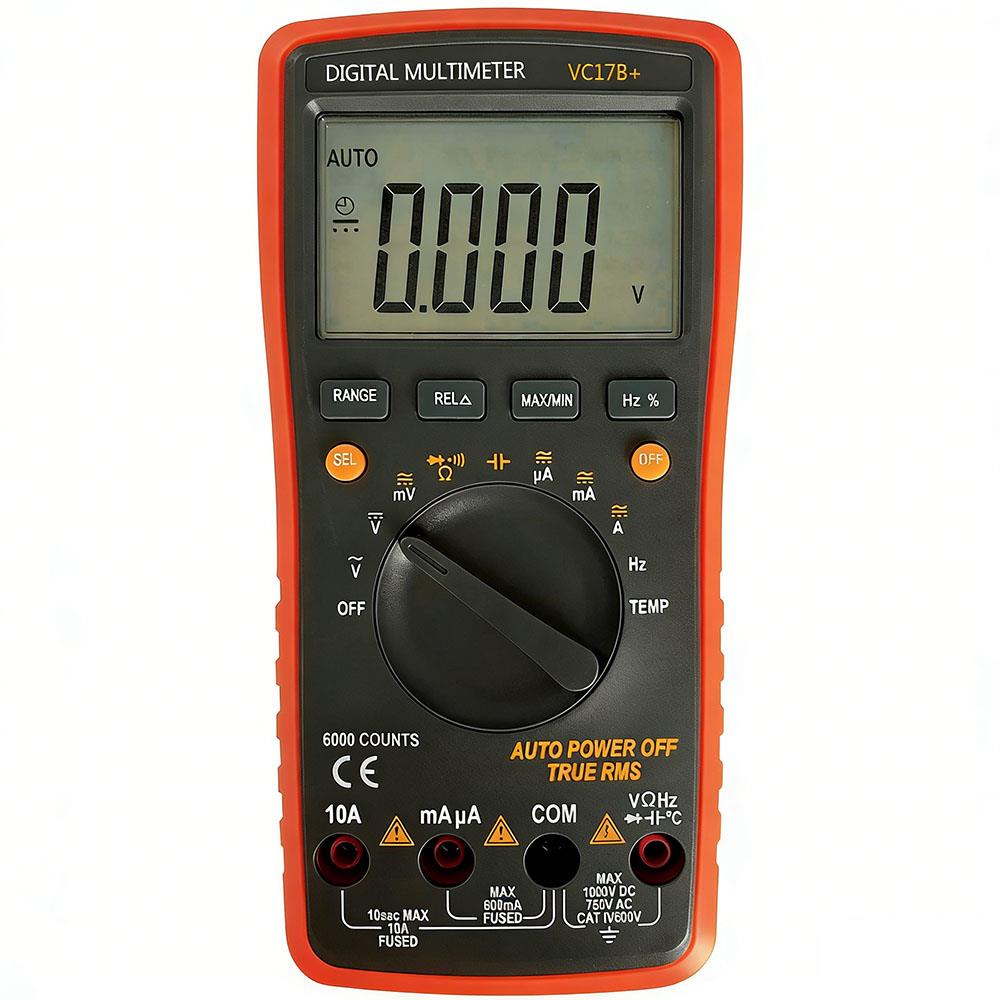
A third case sits between the two. Checking a 24 V control circuit on the 60 V range gives 10 mV steps on the 6000-count instrument and 100 mV steps on the 1999-count one, a factor of ten that shows up immediately when a supply drifts. The 6000-count VC17B+ is built around that kind of work, with a 600 mV to 1000 V DC range and a quoted ±1% on DC volts, and its model guide sets out the full range table.
When a 1999-Count Meter Is the Right Instrument
For continuity checks, diode tests, fuse checks and the ordinary voltage readings on domestic and light commercial circuits, 1999 counts are enough. The readings involved are coarse by nature, the decision is usually pass or fail, and the extra resolution would sit on the last digit where nobody looks. An instrument of that class also tends to be smaller, cheaper and more expendable, which matters on a site where meters get dropped.
The case for 6000 counts is strongest where a reading has to be compared over time or against a tolerance: battery health, supply regulation, sensor output, shunt measurements, and any job where the third digit is part of the specification rather than decoration. It is also stronger where the working voltage sits just above a range boundary, which is the 5 V and 55 V cases in the table above.
What neither class fixes is the accuracy of the measurement as a whole. Leads, contact resistance, temperature and the reference inside the meter all sit outside the count figure, and a 6000-count instrument with a poor reference will be beaten by a 1999-count instrument with a good one. That is why the selection guide starts with the reading, not the display.
Choosing by the Reading You Need to Resolve
Write down the three or four readings the meter will actually be used for, note the range each one would select, and compare the step size on that range between the two candidates. If the steps are the same, the counts are irrelevant and the decision belongs to accuracy, build and price. If the steps differ, the higher count class is solving a real problem and the cost is justified by a measurement rather than by a number on the box.
This is the calculation we run with buyers before a sample is sent, because it is much cheaper to settle before the shipment than after a technician reports that a batch of batteries cannot be graded on the instrument the buyer chose. Tell us the readings, the working voltage and the tolerance you need to hold, and engineers at our factory in Wenzhou will come back with the count class and the range that cover them, plus the model that fits the rest of your requirements.
If you already have a meter on the bench and a reading that looks coarser than you expected, send the model, the range it selected and the number on the display. We will tell you whether the limit is the count class, the range choice or something else in the measurement, and whether a different model in the range would change the answer.