

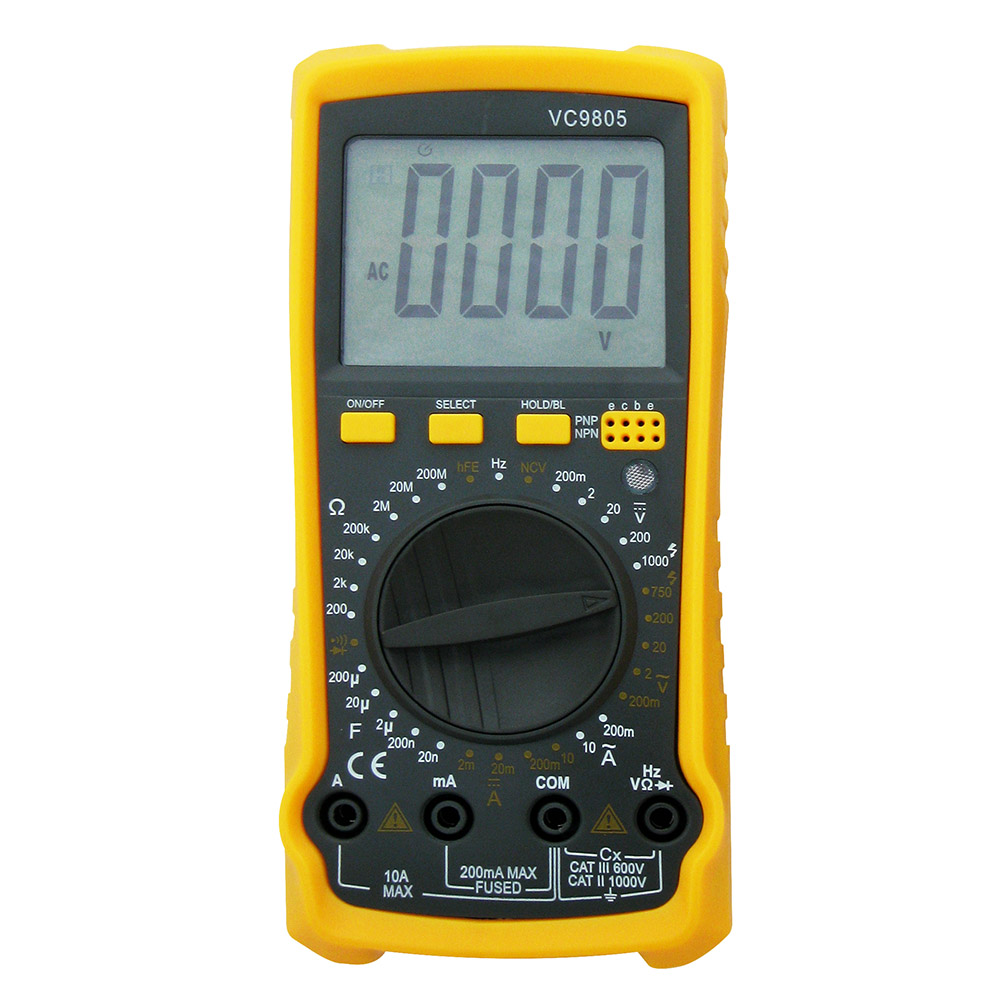
What ±(0.5% + 2) Means on a Multimeter Datasheet
A row on a datasheet that reads ±(0.5% + 2) is not a claim that the meter is wrong by half a percent. It is two errors added together. The first term is a percentage of whatever the display happens to show, so it grows as the reading grows. The second is a fixed number of counts on the last digit, so it stays the same everywhere on that range. On the 200 V range with 100.0 V on the display, the first term is 0.5 V and the second is 0.2 V, which puts the true voltage somewhere between 99.3 V and 100.7 V.
Our Wenzhou factory has assembled 1999-count and 6000-count meters on the same bench for years, and the same comparison goes wrong in most purchase enquiries. A buyer puts a 1999-count meter quoted at ±(0.5% + 2) next to a 6000-count meter quoted at ±(0.8% + 5) and concludes the first one is more accurate. On most of the range the opposite is true, because the reading sits higher on the scale and each count is worth less in volts.
The Percentage and the Counts Measure Different Things
The percentage term comes from the parts that set the slope of the measurement: the voltage divider, the reference, the analogue front end. If the divider is off by 0.5%, every reading on that range is off by 0.5% of itself. Ten volts misses by 50 mV and four hundred volts misses by two volts, and both are described by the same number on the datasheet.
The count term is different in kind. It is a fixed allowance in display steps, and it covers the quantisation error of the converter plus the rounding that happens when a binary number is turned into a decimal digit. Because it is expressed in counts rather than in volts, the same “+2” is worth 0.2 mV on the 200 mV range and 2 V on the 1000 V range. That is why a datasheet cannot be read as a single accuracy figure, and why two meters that both say “0.5%” are not interchangeable.
Working the Number Through a Real Display
A 1999-count meter splits a range into 2000 steps, so one count is roughly the full scale divided by two thousand. On the 200 V range the full scale is 199.9 V and one count is 0.1 V. The table below runs the same ±(0.5% + 2) specification across the five DC voltage ranges of a typical 1999-count instrument.
| Reading on the display | What one count is worth | Total allowed error at ±(0.5% + 2) |
|---|---|---|
| 100.0 mV | 0.1 mV | 0.5 mV plus 0.2 mV, so ±0.7 mV |
| 1.000 V | 1 mV | 5 mV plus 2 mV, so ±7 mV |
| 10.00 V | 10 mV | 50 mV plus 20 mV, so ±70 mV |
| 100.0 V | 100 mV | 0.5 V plus 0.2 V, so ±0.7 V |
| 700 V | 1 V | 3.5 V plus 2 V, so ±5.5 V |
Read down the last column and the shape of the problem becomes obvious. The count term is trivial on the millivolt range and it is more than a third of the total error on the 1000 V range. A buyer who needs to resolve one volt on a four hundred volt reading is not limited by the percentage at all. A buyer who needs to resolve a tenth of a millivolt on a two volt reading is.
Why the Last Digit Is Never Quite Trusted
Turn a meter on with no leads connected and the last digit often moves between two values. That movement is the count error made visible: the converter is producing a number that sits on the boundary between two display steps, and the instrument alternates. It is not a fault and it does not mean the meter is worse than its specification.
The practical consequence is that the last digit carries no information you can rely on. A reading of 12.34 V on a meter whose last digit is worth 10 mV should be treated as 12.34 V give or take the whole ±(0.5% + 2) budget, not as a number accurate to the digit shown. Buyers sometimes ask for a meter with a steadier last digit, and what they usually need is a meter with more counts so the digit they care about is not the last one.
The Same Meter Is More Accurate on Some Ranges Than Others
Because the percentage is tied to the reading and not to the range, the worst place to measure is the bottom of a range. Reading 2.00 V on the 20 V range puts the meter at a tenth of full scale, where the display has fewer significant digits and the count term is a larger share of the answer. Reading 19.00 V on the same range is five times better in absolute terms from the same instrument.
The rule that follows is simple and is worth passing on to whoever uses the meter. Choose the range that keeps the reading as high as possible without going over. If a reading is expected around 12 V, the 20 V range is correct and the 200 V range wastes a digit. Most modern instruments do this automatically, but a manual-ranging model leaves the choice to the operator, and the operator usually leaves the dial where it was.
What the Datasheet Leaves Out
Three things are missing from almost every accuracy row. The first is the temperature coefficient, usually written separately as a fraction of the quoted accuracy per degree outside a 18 to 28 degree band. A meter stored in the back of a van in summer is outside that band, and the error budget grows in a way the headline row does not show.
The second is the resistance of the test leads. On the 200 ohm range, a pair of ordinary leads contributes a few tenths of an ohm, which can be larger than the tolerance of the reading itself. The third is burden voltage on the current ranges: the meter inserts a resistance in series with the circuit, and on the low current ranges that resistance changes the very current being measured. Neither of these is a defect. Both mean the datasheet row describes the instrument, not the measurement.
Comparing Two Datasheets Without Being Misled
To compare two instruments, convert both specifications to the same reading in the same units. A 6000-count meter with ±(0.5% + 5) at 100.00 V resolves 0.01 V per count, so its allowance is 0.5 V plus 0.05 V. A 1999-count meter with ±(0.5% + 2) at 100.0 V resolves 0.1 V per count, so its allowance is 0.5 V plus 0.2 V. The percentages match and the totals differ by a factor of four.
A quote that gives a bare percentage with no count term is incomplete, and a quote that gives a count term with no resolution is unreadable. Ask for both. It takes one message and it removes most of the ambiguity from a comparison that otherwise turns on which brochure had the larger font.
What to Ask Before an Order Is Placed
Four questions settle an accuracy requirement before it reaches a purchase order. Which range will the user actually work on? What is the smallest change in that reading that matters? How far from room temperature will the instrument be stored and used? And what reference will the incoming inspection use to accept or reject a batch?
The answers usually move the specification. A workshop checking 12 V batteries does not need a 6000-count display, and a lab comparing shunts at a few millivolts does. Deciding this before the sample stage means the sample that arrives is the one that can pass the acceptance test, rather than the one that has to be argued about after the container is loaded.
If you are holding two datasheet rows right now, send both to our engineering team with the reading you need to resolve and the range it sits on. Engineers at our Wenzhou factory will tell you which count class and which range actually cover that reading, and back it with a unit measured against a reference before you commit to a batch.