

Why a Car Battery Reads 12.6 V Until You Turn the Key
A battery that reads 12.6 V at rest can still be incapable of starting a car, because open-circuit voltage measures how charged the plates are and says nothing about how much current they can deliver. The number that separates a healthy battery from a tired one is the lowest voltage reached during the first two seconds of cranking, and that number never appears unless someone is watching the display at the moment the starter engages. A warm engine should hold above roughly 10.5 V through the crank; a reading that falls below 9.6 V means the battery is finished, however healthy it looks with the key off.
What Open-Circuit Voltage Does Not Measure
Every lead-acid battery has an internal resistance, and that resistance rises as the plates sulphate and the active material is lost. Resting voltage is set by the chemistry of the plates and is almost unaffected by that resistance, which is why a battery at the end of its life can sit at a perfectly normal 12.6 V on the bench. The resistance only becomes visible when current is drawn, because the drop across it is the current multiplied by the resistance. A starter drawing 200 A through 0.02 Ω loses 4 V inside the battery before the cable sees anything; the same starter through 0.06 Ω loses 12 V, and the engine does not turn. The instrument that shows this is the same voltmeter, read at the wrong moment in the eyes of most people.
Watching the Display While the Starter Turns
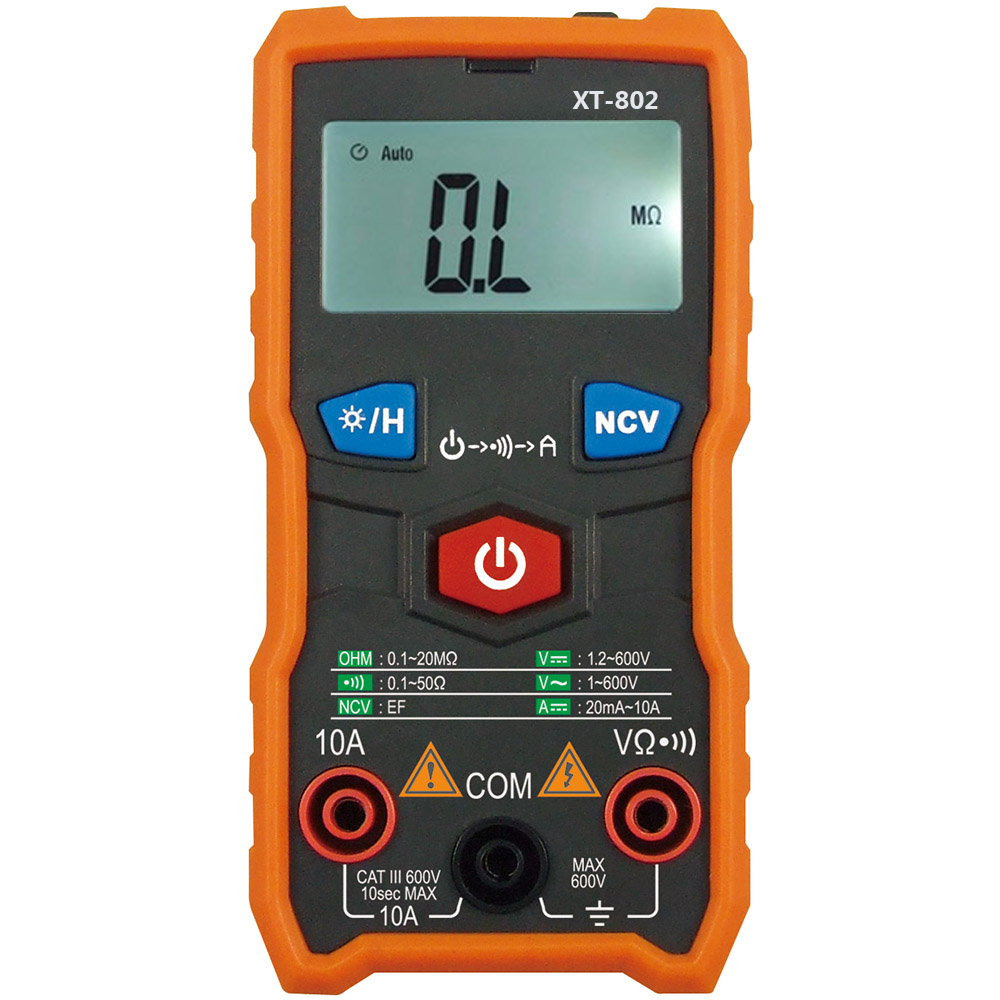
Connect the meter to the battery posts on the DC volts range above 20 V — the 60 V range on the XT802, the 20 V range on a DT33 — and have a second person turn the key. The interesting interval is the first one to two seconds, before the engine catches. A meter with a minimum or maximum hold function captures the dip on its own; without one, the reading has to be caught by eye, and a good digital display updates two or three times a second so the low point is usually visible. Do not crank for more than about ten seconds at a time, and give the starter a minute between attempts, because the reading gets worse the longer the starter runs and the battery is not the only thing being heated.
What the Lowest Number Should Be
Cranking voltage is judged against ambient temperature, because a cold battery has higher internal resistance and a cold engine takes more current. The thresholds below are the ones used for 12 V systems; a vehicle that fails them cold may pass them comfortably on a warm afternoon, which is exactly why a battery that dies on the first frost tested fine in the workshop in September.
| Lowest reading while cranking | Ambient | What it means |
|---|---|---|
| 11.0 V or above | Above 10 °C | Battery is delivering starting current. Look elsewhere for the fault. |
| 10.0 V to 11.0 V | Above 10 °C | Ageing. Still starts now, likely to fail on the first cold morning. |
| 9.6 V to 10.0 V | 0 °C and below | At the published floor for a cold crank. Check the cables before condemning the battery. |
| Below 9.6 V | Any | Battery or starter draw. A load test is now the only useful next measurement. |
| Below 8.0 V | Any | Failed cell or a short in the starting circuit. Stop cranking and diagnose. |
9.6 V Is a Cold-Weather Floor, Not a Target
The 9.6 V figure that circulates as the cranking minimum is a cold-temperature limit for a 12 V system, and treating it as the pass mark on a warm engine lets a tired battery through. At 20 °C a healthy battery holds above 10.5 V through the crank and often nearer 11 V. A battery that reads 10.0 V on a warm afternoon is roughly where a battery that reads 9.6 V in winter sits, and it will be the one that fails in January. Judging by the warm-weather number alone systematically passes the batteries that are about to cause a callout.
When the Drop Is in the Cable and Not the Battery
Before replacing a battery that drops further than it should, measure where the voltage is being lost. Put the red probe on the positive post and the black probe on the starter’s positive terminal, then crank: a reading above about 0.5 V means the cable, the clamp or the terminal is eating the difference. Repeat on the return path — black probe on the negative post, red probe on the engine block — and treat anything above 0.3 V as a connection that needs cleaning or replacing. A ground strap that has corroded to a few strands behaves exactly like a failing battery from the driver’s seat and costs a fraction as much to fix. The instrument handling is the same as in the basic multimeter procedure, and the automotive multimeter guide covers the meters used for it.
What the Alternator Can and Cannot Tell You
A running engine puts the alternator in parallel with the battery, so the 13.8 V to 14.4 V measured at idle is the alternator’s output and not evidence that the battery is sound. A battery with a collapsed cell can sit at 14.2 V all day while the engine runs and be flat again by morning, because the alternator is carrying the load and the battery is contributing nothing. The running reading answers one question only — is the charging system working — and the cranking reading answers the other. If the cranking number is poor and the running number is normal, the battery needs replacing; if both are poor, the alternator and the battery both need attention. The reference for the resting numbers in between is the car battery voltage chart.
Send Us the Lowest Number You Saw
Write down three figures — resting, lowest point during cranking, and running at idle — and almost every starting complaint narrows to one component before anything is unbolted. If you supply workshops, distributors or fleets, send us the cranking figures your customers report and the vehicles behind them, and the engineers in our Wenzhou factory will match them to the meters in the range that can capture a two-second dip reliably; samples are available for evaluation, and you will have a reply within 24 hours.