

VC890 Digital Multimeter Guide: VC890D vs VC890L
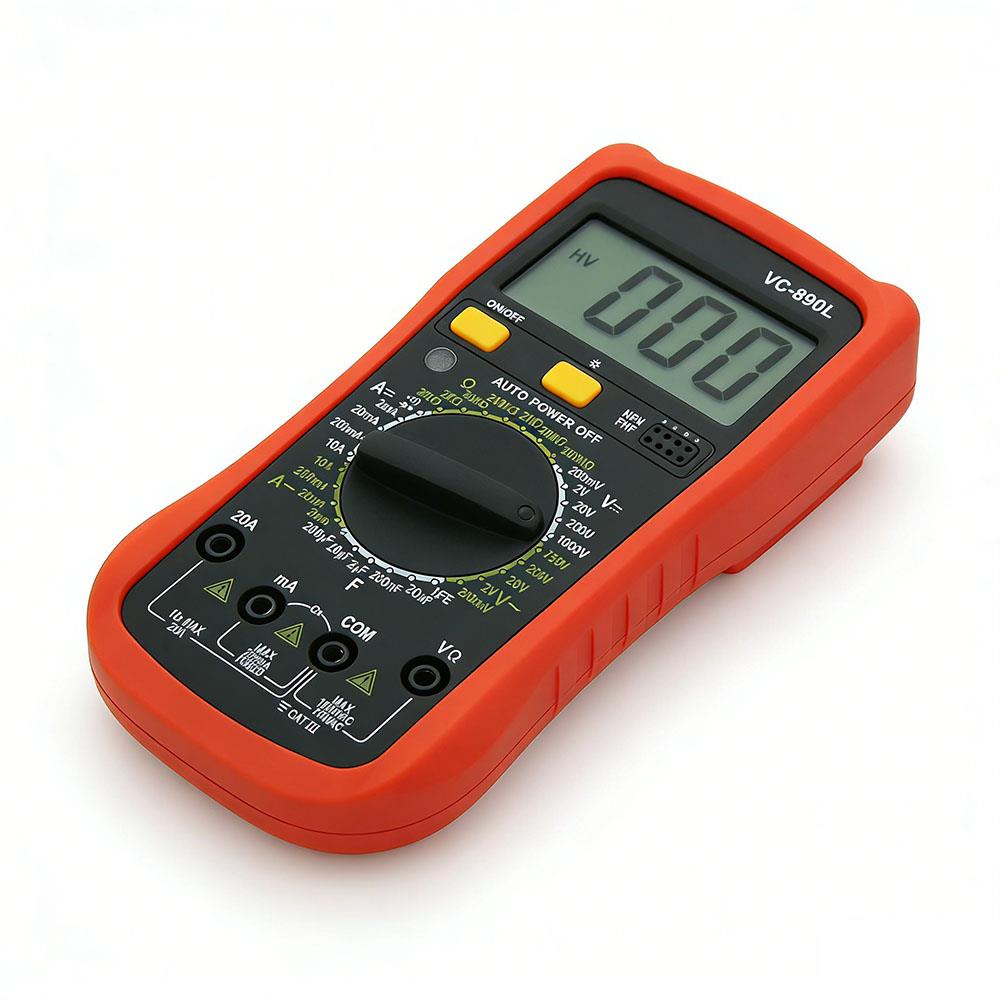
Two model numbers share one housing. The VC890D and the VC890L use the same case, the same dial and the same accuracy figures. Importers ask us the same question every week: which one earns the shelf space?
The One Line That Separates Them
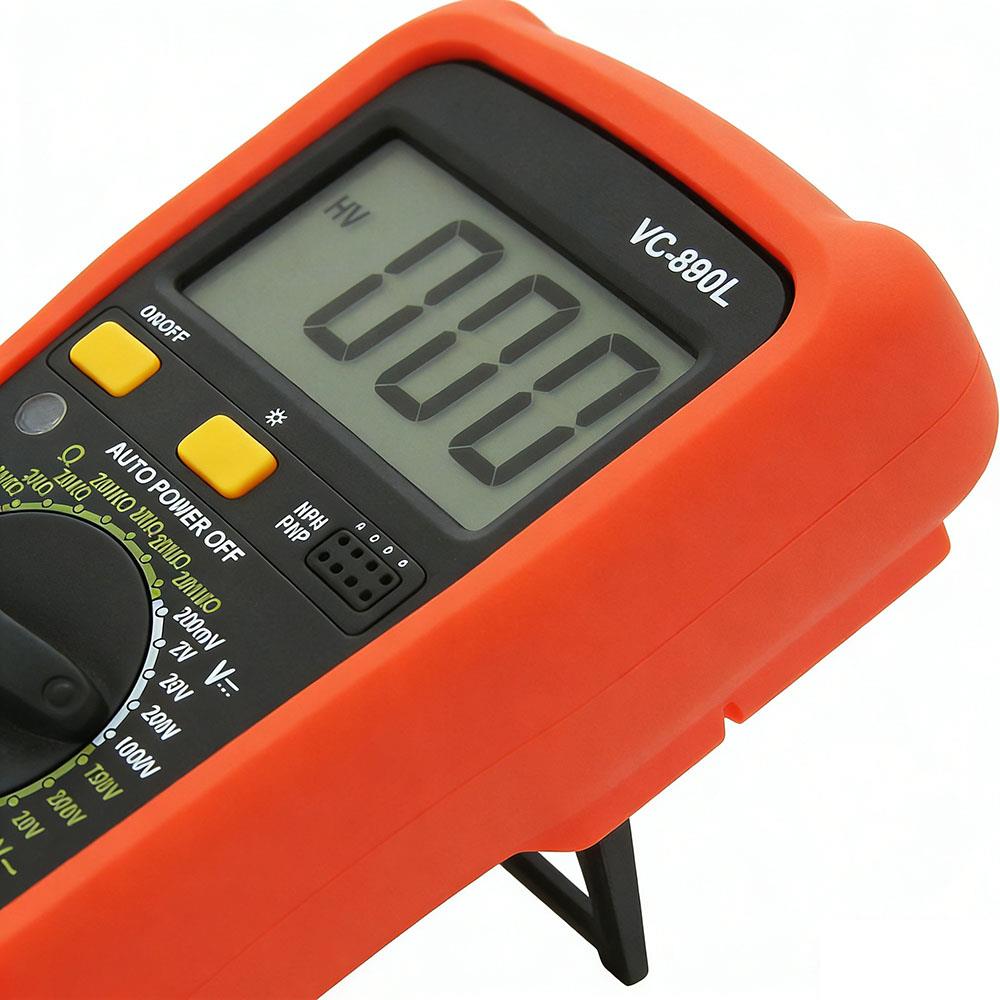
Backlight.
The VC890L has a backlit LCD. The VC890D does not. Everything else in the specification sheet matches, down to the 187 x 95 x 53 mm case and the 270 g weight with the holster fitted.
That single line decides where each meter sells, and it moves your landed cost. The question is not which meter is better built. It is where your customers point the probes.
Where Your Customers Actually Work
Before you split a purchase order between two SKUs, map the places your market uses a handheld meter.
- Distribution boards and meter cabinets, frequently in service corridors with no ceiling light.
- Crawl spaces, ceiling voids and plant rooms.
- Bench work, repair counters and teaching labs.
- Emergency callouts after dark.
If your volume goes to electricians and maintenance crews, the backlight stops being a luxury. A technician holding a probe against a live terminal inside a dark cabinet has no free hand for a torch. He needs the display itself to glow.
Schools, repair benches and hobby channels are a different story. Those meters sit under strip lights or on a desk. The VC890D covers the same ranges and costs less, which is why it still moves in volume in those channels.
VC890D vs VC890L, Range by Range
| Specification | VC890D | VC890L |
|---|---|---|
| Display | 1999 count (3.5 digit), 62 x 35 mm LCD | 1999 count (3.5 digit), 62 x 35 mm backlit LCD |
| Backlight | No | Yes |
| DC voltage | 200 mV to 1000 V, ±1.5% | 200 mV to 1000 V, ±1.5% |
| AC voltage | 200 mV to 750 V, ±1.8% | 200 mV to 750 V, ±1.8% |
| DC current | 2 mA to 10 A, ±3.0% | 2 mA to 10 A, ±3.0% |
| AC current | 2 mA to 10 A, ±3.5% | 2 mA to 10 A, ±3.5% |
| Resistance | 200 ohm to 20 Mohm, ±2.0%; 200 Mohm, ±7.0% | 200 ohm to 20 Mohm, ±2.0%; 200 Mohm, ±7.0% |
| Capacitance | 20 nF to 200 uF, ±5.0% | 20 nF to 200 uF, ±5.0% |
| Diode and transistor | Diode test, hFE socket | Diode test, hFE socket |
| Continuity | Audible buzzer | Audible buzzer |
| Data hold | Yes | Yes |
| Overload protection | All ranges | All ranges |
| Battery | One 9 V (6F22) | One 9 V (6F22) |
| Case | 187 x 95 x 53 mm, about 270 g with holster | 187 x 95 x 53 mm, about 270 g with holster |
What the Dial Covers
The dial is manual, with the usual DCV, ACV, DCA, ACA, resistance, capacitance, diode and hFE positions around it. Nothing here is hidden behind a menu.
Voltage runs from 200 mV up to 1000 V DC and 750 V AC, which covers control wiring, single-phase sockets and most three-phase work. Resistance spans 200 ohm to 20 Mohm on the main ranges, with a 200 Mohm range that trades accuracy for reach. Capacitance starts at 20 nF, low enough to sort small ceramic and film capacitors, and stops at 200 uF, which takes in motor run capacitors and most start capacitors.
The hFE socket is a legacy feature, and we say so plainly. It reads small-signal transistor gain, and no one repairing switch-mode boards uses it. Buyers who came up on 1990s bench meters still ask for it, so it stays.
The Two Ranges Buyers Ask About Most
Current is the range that generates support tickets, and it is worth explaining before your customers do.
Measuring current means breaking the circuit and putting the meter in series. On a 10 A load, the meter becomes part of the circuit, and a wrong dial position at that moment is how meters get destroyed. The VC890D and VC890L both carry overload protection on every range, but protection is a backstop, not a licence. Show your buyers the correct lead positions in the manual and in your listing copy.
Capacitance is the range that sells the meter. Appliance and HVAC technicians need to check a run capacitor, and the VC890 covers the values they meet. Discharge the capacitor first, every time. A charged capacitor will damage the meter and can hurt the person holding it.
Where the VC890 Is the Wrong Meter
Three limits, stated before you commit to a container.
The VC890 is average-responding on AC, not true RMS. On clean mains sine waves that makes no difference. On inverter outputs, variable-speed drives and switch-mode supplies the reading is approximate, so do not market it as a drive service meter. We make other models for that work.
The 1999 count display is another limit. Three and a half digits resolve 1 mV on the 2 V range, which is fine for a battery or a sensor supply, and not fine for calibration paperwork.
Finally, there is no temperature range, no frequency counter and no non-contact voltage detector on this series. If your buyers ask for any of those, the VC9805 is the step up. For a cheaper shelf-filler in the same class, the DT830 covers the basics. And for panel and motor current work, a clamp meter is the right tool rather than any handheld in this class.
What One Carton Holds
Both models ship the same way. Each meter goes out in a colour box with the battery fitted, the holster, a test lead and a manual. Forty boxes to a carton, carton size 43.5 x 30.5 x 51 cm, gross weight 16.4 kg against 15.4 kg net.
Those numbers matter more than they look. A 16.4 kg carton is a one-person lift on a loading dock and stacks two high on a standard pallet footprint. If your warehouse or your last-mile carrier works to a weight limit, forty units is a comfortable unit of order for the VC890 series.
Order One of Each, Then Set Your SKU Mix
The honest answer to the VC890D versus VC890L question is that both belong in a catalogue. Stock the D for price-led channels and the L for trade counters, then let the reorder pattern tell you the ratio.
Order a sample of each from our Wenzhou factory, test them against the meter you already stock, and compare the backlight against the conditions your customers describe. Both models sit in our VC890 series, and both can ship under your own brand through our OEM program. Give us the two quantities you are considering and we will quote both, with lead time and carton breakdown, so you can size the first container properly. Send us your target quantities and our engineers will confirm the configuration.