

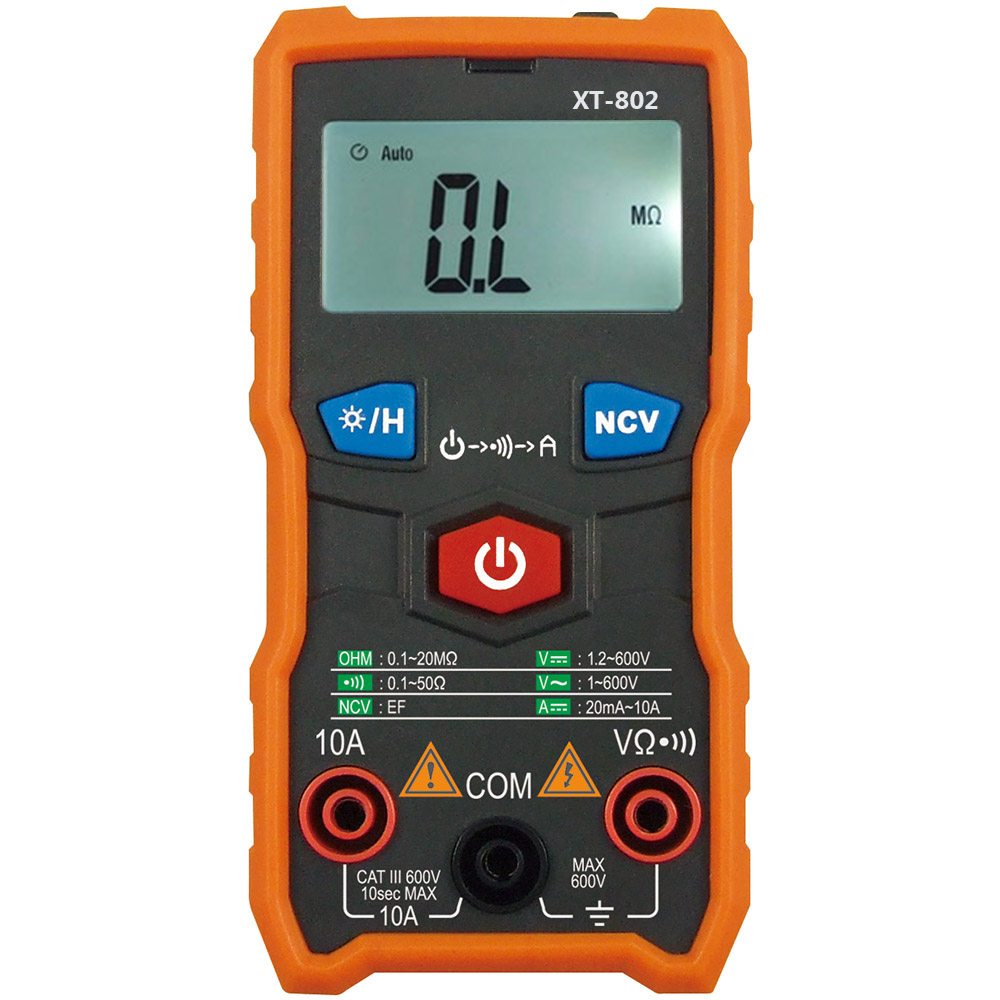
XT802 Digital Multimeter: 6000 Counts, Auto-Ranging, No Dial to Set
Most compact meters make you choose the range before you can trust the reading. You turn the dial, guess whether a 230 V socket sits on the 600 V step or the 1000 V step, and re-measure when you guess wrong. The XT802 takes that decision away: it is a 6000-count auto-ranging meter, and it picks the range itself.
We build the XT802 in our Wenzhou factory, and every figure in this guide comes from the production specification sheet. It is written for the electrician who wants one less thing to think about on a ladder, and for the distributor deciding whether this SKU earns shelf space next to the DT830 class.
Where the XT802 Sits in a Working Range
The DT830 class is the entry tier: a 1999-count display and a manual dial that covers the four measurements a beginner needs. The DT700 series is the compact workhorse with tighter DC accuracy. The XT802 is the step that changes how you use the meter rather than how accurate it is: 6000 counts of resolution and auto-ranging, in a case that still fits a tool pouch at 121 by 60 by 36 mm and about 120 g with its holster.
That combination is the point. A 6000-count display shows readings up to 5999 instead of 1999, so small changes stay visible instead of disappearing into a single digit. Auto-ranging means the meter does the dial work: touch the probes and read.
What the XT802 Measures
DC voltage spans 6 V to 600 V at ±1.3%, and AC voltage 6 V to 600 V at ±1.8%. Resistance runs 600 Ω to 60 MΩ at ±2.0%. DC current spans 20 mA to 10 A at ±1.8%, and AC current the same span at ±2.2%. Capacitance reaches from 4 nF to 40 mF at ±10.8%, which covers start and run capacitors in appliance and HVAC work.
Read the bottom of those ranges as carefully as the top. There is no millivolt range, so millivolt-level bench work sits outside what it is built for. This is a meter for installation and troubleshooting on mains circuits, not a bench instrument for low-level electronics work; if that is the job, a full-size model with a 400 mV range is the right tool.
What Auto-Ranging Actually Changes
Three things, and they all show up on a normal day. First, speed: no dial to turn between a socket check and a continuity check, so you move through a fault-finding sequence without looking down. Second, fewer wrong readings: a manual meter left on the wrong step gives you a number that looks plausible and is not, and auto-ranging removes that whole class of mistake. Third, resolution where it matters: on the 6000-count display a slow drift on a battery or a voltage drop across a joint is visible as a changing number rather than a single flickering digit.
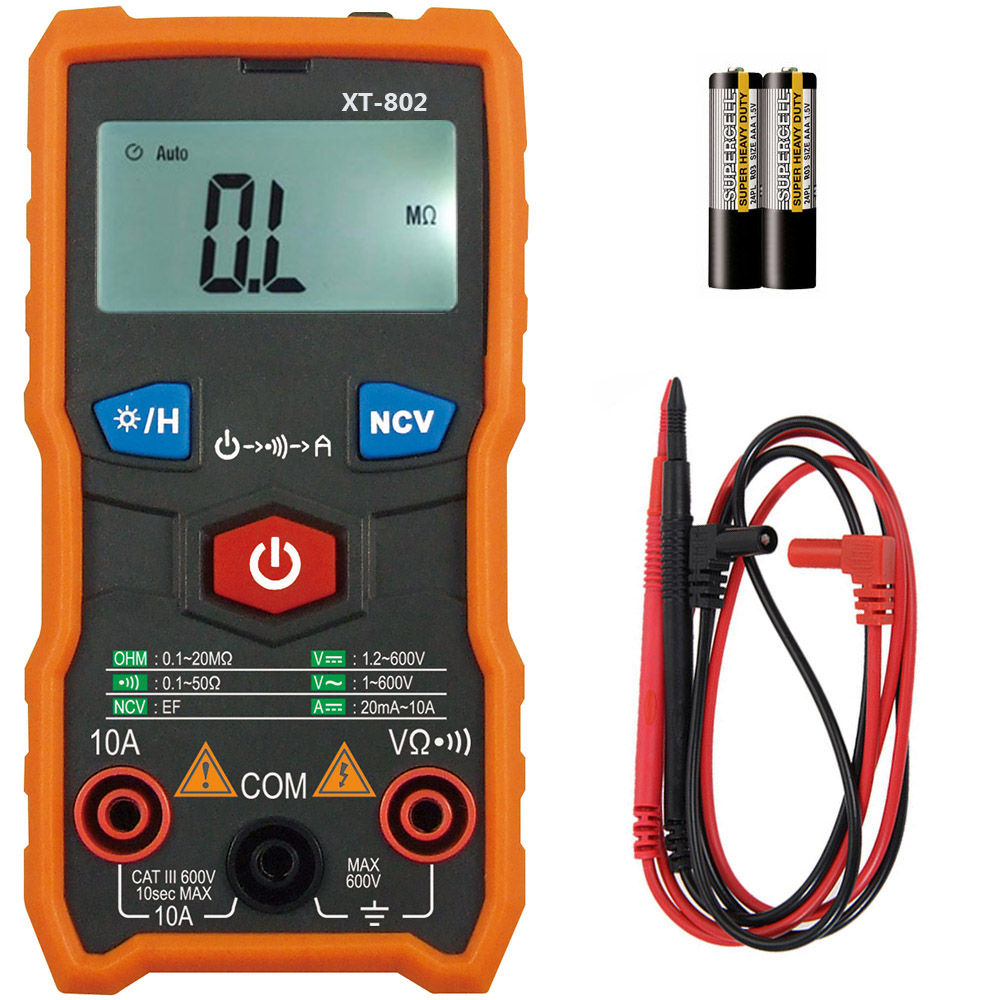
The face carries three oval buttons for backlight and data hold, power conversion and non-contact voltage detection. That last one is worth naming: NCV lets you sweep a conductor or a junction box before you put the probes anywhere near it, which is the cheapest safety habit in electrical work.
The Safety Rating, Stated Plainly
The panel is printed CAT III 600 V, with the jack row marked MAX 600 V and 10 A / COM / VΩ. CAT III covers the fixed installation itself: distribution boards, feeder circuits and panel-mounted equipment, where the available fault energy is higher than at a socket. That rating is what lets the XT802 go to the panel and not only to the outlet. The CAT rating explained article walks through which category applies to which location.
What the XT802 Does Not Do
It has no temperature function, so motor, bearing and termination checks are not its job; a meter with a type-K input covers those and there is a model in our range built for exactly that. It has no clamp jaws, so measuring a live conductor without breaking the circuit means a clamp meter and not a multimeter. Knowing the edges of a tool is what keeps it from being the wrong tool.
For the Buyer Stocking the XT802
The commercial case is straightforward. The XT802 gives a store a 6000-count auto-ranging meter at the compact end of the line, sitting above the 1999-count basics without competing with the full-size bench models. Auto-ranging is an easy feature to demonstrate across a counter, and 6000 counts is a specification a customer can compare on the box without needing an explanation.
It ships in a colour box, 50 pieces per carton, carton size 55.5 by 31.5 by 24 cm, gross 12 kg and net 11 kg. Standard accessories are the meter with its battery fitted, a holster, a test lead and a manual. OEM branding and packaging are available when you order it for your own line, and every unit passes the same calibration and function check before it leaves the factory under CE and RoHS compliance.
Ask us for carton and lead-time figures for your region before you commit to a quantity. We ship samples first, and the 12-month warranty and 24-hour engineer response cover the whole range whether you buy one unit or a container.
Bench-Test an XT802 Against the Meter You Stock
Do not take the specification sheet as enough. Order a sample XT802, put it next to the meter your shop currently sells, and run the checks you face in a normal week: a socket voltage read, a continuity check on a suspect lead, one capacitance measurement on a failed appliance, and a sweep with the NCV button before you disconnect anything. Then tell us what you found, the ranges your customers actually ask for, and the quantity you are planning. Our Wenzhou engineers reply within 24 hours, confirm whether the XT802 fits your line, point you to the DT700 series when you need a smaller meter or to a clamp meter when you need to read current without breaking the circuit, and quote per-unit pricing once we know your numbers.