

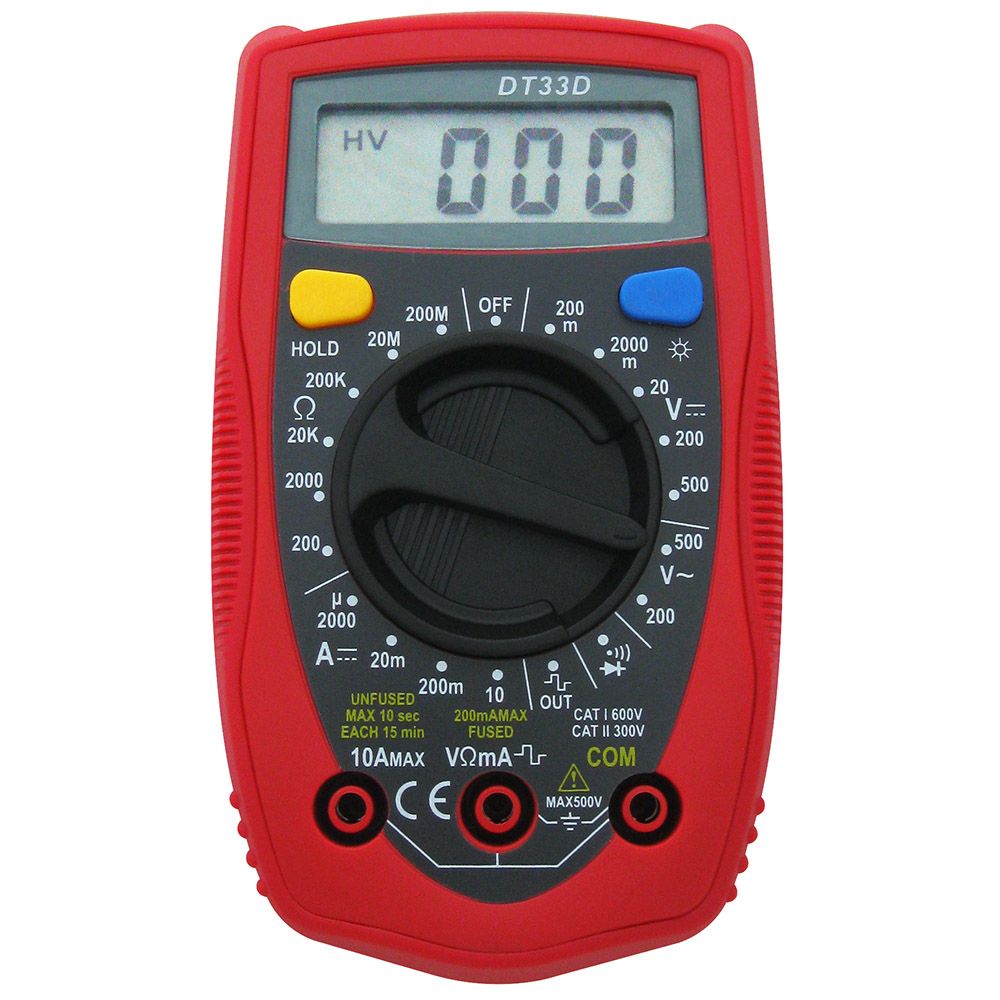
DT33 Digital Multimeter Guide: DT33B vs DT33C vs DT33D
Three model numbers share one housing and one price band. Each DT33 variant adds a different third function, and that decides which one earns shelf space in your market.
One Housing, Three Third Functions
The whole family reduces to three lines.
- DT33B adds a battery test on 1.5 V, 9 V and 12 V.
- DT33C adds temperature, from -20 °C to 1000 °C.
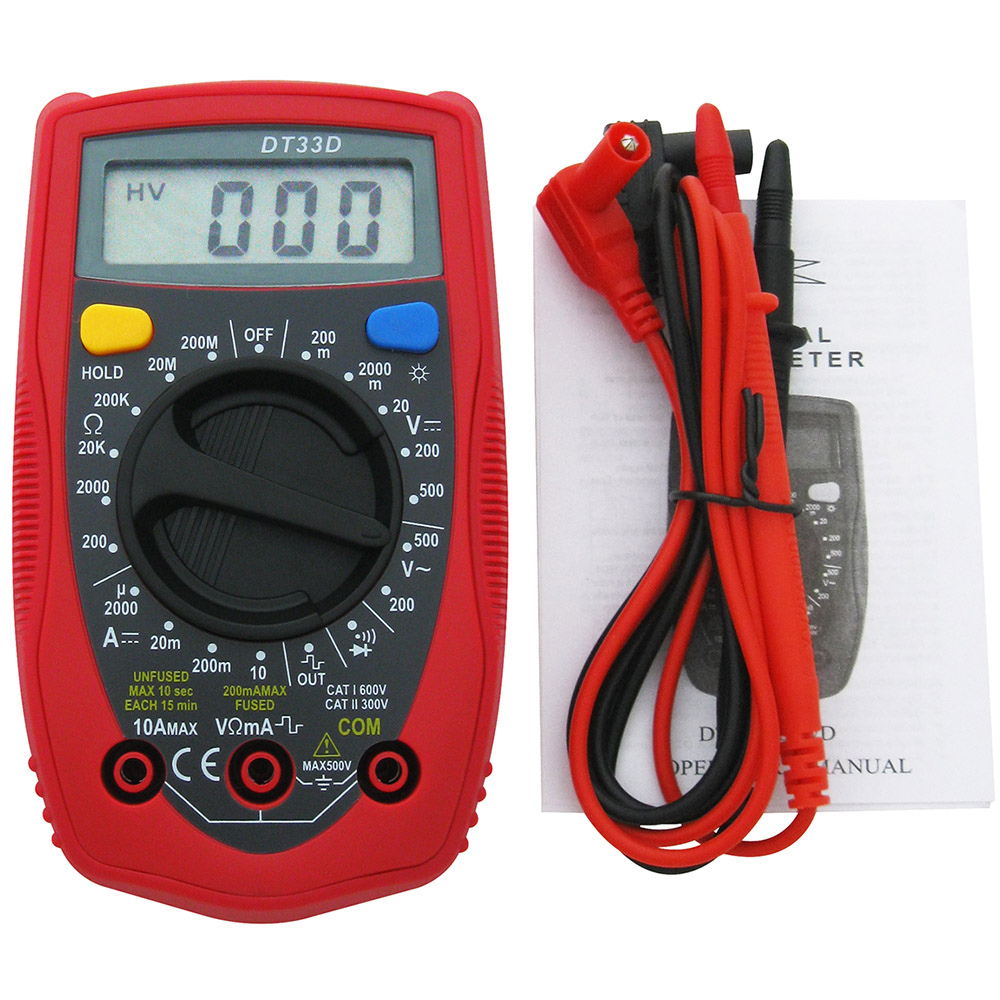
- DT33D adds a square wave output.
Nothing else separates them. Same LCD. Same buttons. Same holster. Same colour box. If you already stock one of the three, you know how the other two will feel in the hand and how much shelf they take.
That is the practical value of a shared platform. A mixed order does not mean three sets of spare parts. It does not mean three manuals to localise, or three different footprints in a display case. Your buyers see one familiar meter with a choice of extra function. Your warehouse sees one line item family, and your freight forwarder sees one carton specification.
Importers who carry all three usually tell us the same thing after the first container. The variants sell as a set, not as competitors. A customer who buys the temperature version often comes back for a second unit without the temperature probe, because the shop floor and the office bench need different meters.
What All Three Meters Share
Before the differences, the baseline that applies to every DT33 unit we ship.
- DC voltage from 200 mV to 500 V, ±1.0%
- AC voltage from 200 V to 500 V, ±2.2%
- 1999-count display on a 48 x 17 mm LCD
- Diode test and a continuity buzzer
- Data hold and a backlit screen
- Overload protection on every range
- Low battery indication
- One 9 V 6F22 battery
- Case size 132 x 76 x 36 mm, about 170 g
The 500 V ceiling is worth catching early, because it shapes what you can promise in your listing copy. It covers single-phase sockets, lighting circuits and most commercial wiring. It stops short of the 1000 V DC range our VC890 series carries. If your buyers routinely stand in front of 600 V equipment, this is not the series for that job.
The display is a plain 1999-count LCD measuring 48 x 17 mm. There is no bar graph. There is no auto power off timer to explain in the manual, and no menu system. A buyer picks up the meter and measures. That simplicity is a selling point in markets where the end user is a homeowner, an apprentice or a general maintenance hand rather than an electronics engineer.
The jack row runs 10 A, VΩmA and COM. All three sockets carry red rings. A red ring is a small thing that matters at the counter, because it makes the correct socket visible in low light and reduces the number of returns caused by a probe in the wrong hole. The HOLD button sits on the left of the panel and the backlight button on the right, so neither is pressed by accident when a thumb moves across the face.
Every unit ships with the battery already fitted. That sounds trivial until you compare it with competitors who ship the cell loose in the box. A fitted battery means the meter works the moment the customer opens it, which matters for markets where the retail staff will not open a box to demonstrate a product.
DT33B vs DT33C vs DT33D, Spec by Spec
| Specification | DT33B | DT33C | DT33D |
|---|---|---|---|
| DC voltage | 200 mV to 500 V, ±1.0% | 200 mV to 500 V, ±1.0% | 200 mV to 500 V, ±1.0% |
| AC voltage | 200 V to 500 V, ±2.2% | 200 V to 500 V, ±2.2% | 200 V to 500 V, ±2.2% |
| DC current | 200 uA, 200 mA, 10 A, ±2.5% | 2000 uA, 20 mA, 200 mA, 10 A, ±2.5% | 2000 uA, 20 mA, 200 mA, 10 A, ±2.5% |
| Resistance | 200 ohm to 20 Mohm, ±1.5% | 200 ohm to 200 Mohm, ±5.0% | 200 ohm to 200 Mohm, ±5.0% |
| Battery test | 1.5 V, 9 V, 12 V | No | No |
| Temperature | No | -20 °C to 1000 °C, ±3.0% | No |
| Square wave output | No | No | Yes |
| Display | 1999 count, 48 x 17 mm LCD | 1999 count, 48 x 17 mm LCD | 1999 count, 48 x 17 mm LCD |
| Backlight | Yes | Yes | Yes |
| Data hold | Yes | Yes | Yes |
| Diode and continuity | Diode test, buzzer | Diode test, buzzer | Diode test, buzzer |
| Overload protection | All ranges | All ranges | All ranges |
| Low battery indication | Yes | Yes | Yes |
| Battery | One 9 V (6F22) | One 9 V (6F22) | One 9 V (6F22) |
| Safety rating | CAT I 600 V / CAT II 300 V | CAT I 600 V / CAT II 300 V | CAT I 600 V / CAT II 300 V |
| Case | 132 x 76 x 36 mm, about 170 g | 132 x 76 x 36 mm, about 170 g | 132 x 76 x 36 mm, about 170 g |
The Two Rows That Actually Differ
Fourteen rows in that table are identical across the three models. Two are not, and most buyers spot the first while missing the second.
Resistance is the visible one. The DT33B is published at ±1.5% across 200 ohm to 20 Mohm. The DT33C and DT33D go one range further, out to 200 Mohm, and their resistance row is published at ±5.0%.
Read those two lines against each other and the trade becomes clear. The B gives up the top decade and gains a tighter published tolerance on the five ranges that board-level repair actually uses. The C and D reach far enough to look at insulation leakage and high-value resistors, at a wider tolerance.
For continuity work and resistor sorting on small boards, the B figure is the one worth sampling. For insulation and leakage checks where you mainly need the reading to exist at all, the C and D reach it. Neither is a defect. They are two different jobs.
Current is the row buyers skim past. It deserves more attention than it gets, because the range boundaries differ between the B and the other two.
The DT33B carries three DC current ranges: 200 uA, 200 mA and 10 A. The DT33C and DT33D carry four: 2000 uA, 20 mA, 200 mA and 10 A.
On a 1999-count display, that changes what the meter can show you. A 15 mA current measured on the B lands on the 200 mA range and reads 15.0 mA. On the C or D it lands on the 20 mA range and reads 15.00 mA. Same accuracy figure, one extra digit of resolution, because the range boundary sits in a different place.
At the bottom of the scale the advantage flips. The B’s 200 uA range resolves down to 0.1 uA. The C and D start at 2000 uA and resolve to 1 uA. If your buyers work on very small currents, the B is the finer instrument at that end.
What 1999 Counts Resolves in Practice
Counts confuse buyers more than accuracy figures do, and the confusion costs you returns. Here is the arithmetic in plain terms.
A 1999-count display shows four digits with the leading digit limited to 1. On the 200 mV range the meter tops out at 199.9 mV, so the smallest step it can show is 0.1 mV. On the 2 V range it tops out at 1.999 V, so the step is 1 mV. On the 20 V range the step is 10 mV, and on the 200 V range it is 0.1 V.
Read that pattern and the practical limit becomes obvious. The resolution follows the range, not the reading. A 5 V measurement taken on the 20 V range shows 5.00 V. The same measurement on the 200 V range shows 5.0 V. Buyers who do not understand this file support tickets claiming the meter lost a digit.
Put a line in your listing copy telling customers to pick the lowest range that still fits the reading. It is one sentence, and it prevents a category of complaint that has nothing to do with the meter’s quality.
Accuracy in Plain Numbers
Percentages on a datasheet mean little to a distributor sizing up a market. Converted into the units a buyer actually sees, they mean a lot.
At ±1.0% on DC voltage, a 12 V battery reading carries about ±0.12 V of tolerance. Mains voltage measured at 230 V carries about ±2.3 V. Both are fine for deciding whether a supply is healthy and both are far too loose for calibration paperwork.
At ±2.2% on AC voltage, the same 230 V reading carries about ±5 V. That is the figure to quote when a buyer asks whether the meter can confirm that a socket is at nominal voltage. It can confirm nominal. It cannot certify it.
Resistance is where the three models separate in daily use. At ±1.5%, a 1 kohm resistor on the DT33B reads within about ±15 ohm. At ±5.0%, the same resistor on the DT33C or DT33D reads within about ±50 ohm. For sorting resistors into bins, the tighter figure is worth the lost top decade. For finding a shorted winding or a failed heating element, both figures are more than adequate.
DC current at ±2.5% puts a 5 A reading within about ±0.125 A. That is a normal figure for this class of meter and it is the reason the 10 A range is a diagnostic tool rather than a measurement instrument.
When the Battery Test Sells the Meter
Battery test is the function that turns a meter into a counter sale. A customer walks in with a device that will not start, and the first question is always whether the cells are flat.
The DT33B answers that question without a second instrument. Load positions for 1.5 V, 9 V and 12 V cover the three cell types that fill a hardware drawer, and the reading appears on the same display through the same probes as every other measurement.
Where this matters commercially: retail counters, hardware shops, appliance repair desks and any market where household batteries are sold next to tools. If your buyers already stock a standalone battery tester, the DT33B competes with it directly and removes a line item from their shelf. We cover that category separately in our guide to battery and temperature testers if you want the comparison before you set your range.
One caution for your listing copy. A battery test on a multimeter reads the cell under a light load. It is a go or no-go check, not a capacity measurement. Do not let the copy drift toward claims about remaining charge, because a customer who expects a percentage will be disappointed and will return the meter.
When Temperature Sells the Meter
The DT33C measures from -20 °C to 1000 °C, which is the range that puts a meter into HVAC and refrigeration work.
Contact temperature covers what an infrared gun cannot. A technician checking a compressor discharge line, a supply-air duct or a motor housing wants the number at the point of contact rather than an average over a cone of infrared. That is the DT33C’s job, and it is why this variant moves in markets with a strong air-conditioning service trade.
The 1000 °C ceiling is higher than most buyers need. Domestic and light commercial refrigeration work rarely goes past a few hundred degrees. The extra headroom matters for markets that service ovens, kilns and industrial heating, and it costs nothing to have.
Two practical notes for your listing copy. First, the temperature function needs the thermocouple probe fitted, so confirm the accessory set with us before you print a box that shows one. Second, a 1999-count meter resolves temperature in whole degrees. That is enough for service calls and fault-finding, and not enough for calibration records. If your buyers need traceable temperature, the VC9805 is the step up, and our HVAC guide covers the rest of that toolkit.
There is a commercial argument for the C that has nothing to do with accuracy. A distributor who stocks a temperature-capable meter stops losing the refrigeration trade to a specialist supplier. The order that would have gone elsewhere stays in your catalogue.
When the Square Wave Sells the Meter
Square wave output is the least understood of the three, and it is the one that wins a specific kind of buyer.
The output gives a technician a known signal to inject. Tracing an audio path, checking whether a stage of a circuit responds at all, or confirming that an input is alive stops being guesswork when you can feed a clean square wave in at one end and follow it with the same meter at the other.
That use case lands with electronics repair shops, vocational schools and technical training programmes. Education buyers in particular order in class-sized quantities, because a signal source built into the meter removes a bench instrument that students would otherwise queue for.
Be straight with your buyers about what it is not. This is a signal source for tracing, not a function generator. If your market expects sine, triangle or adjustable-frequency output, the DT33D will disappoint them, and we would rather you knew that before the container ships.
For a distributor, the D is often the variant that opens a school or institutional account. Those buyers order predictably, reorder annually, and rarely shop on price alone. One education account can absorb more units than a dozen retail counters.
Matching Each Variant to a Channel
Specifications decide what a meter can do. Channels decide which one you order, and the two do not always line up.
Retail and hardware channels fit the DT33B. The battery test is visible on the packaging, understandable in one sentence, and useful to a homeowner standing at a counter. That is the profile of a product that sells without a demonstration.
HVAC and refrigeration distribution fits the DT33C. These buyers know what a thermocouple is, they ask for temperature before anything else, and they will pay a step up for it. If your market has a summer air-conditioning season, this is the variant that carries your margin.
Electronics supply and education fit the DT33D. Order sizes are lumpier and the sales cycle is longer, but the accounts are stable and the price sensitivity is lower. A vocational school replacing a classroom set of meters is a predictable annual order rather than a seasonal one.
General wholesale and mixed-category importers can carry all three and let the reorder pattern do the deciding. Because the carton specification is identical, a mixed purchase order does not complicate your freight or your landed cost per unit.
What Your Listing Copy Should Say
Most of the returns we see on this class of meter trace back to copy, not hardware. Five sentences prevent almost all of them.
State the count. Saying 1999-count, or three and a half digits, sets the right expectation before the customer compares your listing with a 6000-count meter at a higher price.
State the safety rating. Write CAT I 600 V and CAT II 300 V into the specification block rather than leaving it in a manual the customer never opens. It protects the buyer and it protects you.
State what is not included. If the variant in the listing has no temperature probe, say so in the same paragraph as the temperature specification. A missing accessory is the single most common cause of a return on a multi-variant product line.
State the resolution rule. One line explaining that the lowest range that fits the reading gives the finest display removes a whole category of complaint.
Finally, keep the three variants on separate listings. Merging them into one page with a dropdown invite confusion, because the specifications differ in exactly the rows a buyer scans first.
Where the DT33 Is the Wrong Meter
Four limits, stated before you commit to a purchase order.
The safety rating is CAT I 600 V and CAT II 300 V. That covers socket-outlet and appliance-level work, which is where these meters are designed to be used. It is not a distribution-board rating and it is not a three-phase service rating. Do not let your listing copy imply otherwise. Our CAT ratings guide explains what each category actually permits.
The voltage ceiling is 500 V on both DC and AC. That is fine for single-phase and light commercial work, and insufficient for the 600 V and 750 V jobs that other series in our range handle.
The published range table carries no capacitance range, no frequency counter and no non-contact voltage detection. If any of those three is a standard requirement in your market, the DT33 family is the wrong starting point. The VC890 adds capacitance. The DT830 is a cheaper shelf filler when all you need is the basics.
And 1999 counts is three and a half digits. It resolves 1 mV on the 2 V range, which is realistic for batteries and sensors, and unrealistic for anything that ends up in a calibration file.
What One Carton Holds
Each meter ships in a colour box with the holster, a test lead and a manual. Sixty boxes to a carton, carton size 30.8 x 28.3 x 62 cm, gross weight 15 kg against 14 kg net.
Sixty units at about 170 g each leaves roughly 5 kg of the gross weight for packaging. That tells you the box is sized for retail display rather than for shipping density. If your channel is online or trade-counter rather than shelf-facing, ask about the bulk pack option when you request a quote. For cost-sensitive programmes we ship bulk packs with a plain carton and your label applied, and that changes both the unit cost and the carton count.
All three variants pack to the same figures, which keeps your landed cost per unit level across the family. A 15 kg carton is a one-person lift on a loading dock, and it stacks without a pallet-height problem on standard sea freight.
For a first order, one carton of each variant is a realistic starting point. Sixty meters per model gives you enough units to supply a few counters and enough spare stock to replace a warranty unit without breaking another carton.
Sample Orders and Lead Time
Samples ship ahead of a container order, and we would rather send three than one. A single sample tells you how a meter feels. Three samples of the same platform tell you which variant your market reaches for, which is the decision that actually matters here.
Tell us the variants you want and the market they are going into, and we will quote the sample set with the accessory list for each model. The temperature version needs its thermocouple probe confirmed before the sample ships, because that accessory changes the box contents and the unit cost.
For production orders, lead time depends on whether you take the standard colour box or a custom print run. Standard packaging moves faster. Custom artwork adds a print minimum and an approval step, so build that into your schedule if you are launching under your own brand.
Run One Real Fault Through All Three First
Choosing between the DT33B, the DT33C and the DT33D from a spec table is guesswork. Choosing from one repair is not.
Take a single fault your market brings in every week. A flat 9 V cell. A compressor line that reads hot. A board that will not pass signal. Buy one sample of each variant, run the same fault through all three, and watch which function your buyer reaches for first. That answer, not the datasheet, is what should set your opening order ratio.
We build the DT33 family at our Wenzhou factory, so samples and production come from the same line. All three variants sit in our DT33 series, and all three can ship under your own brand through our OEM program, with custom labels and packaging. The rest of the range is in our digital multimeters category if you want to compare this family against the higher-spec models.
Send us your target quantities and tell us which third function your market asks for most. Our engineers will come back with the mix, the lead time and the carton breakdown for the three variants, so you can size the first order properly.