

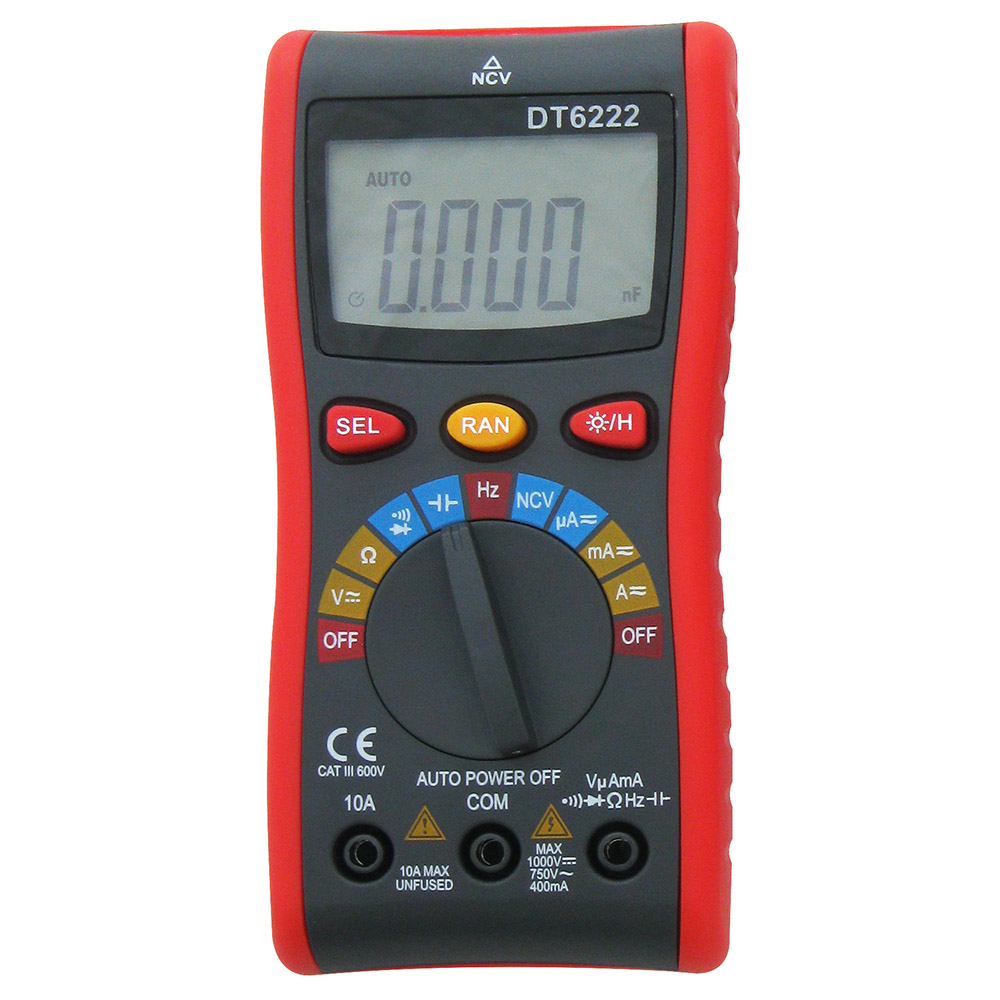
DT6222 Digital Multimeter: CAT III 600V for Work at the Distribution Board
Where you are standing decides which meter is safe, not how much you paid for it. A meter rated CAT II is built for socket circuits and appliance feeds; the moment the work moves inside a distribution board, the transient energy goes up and the rating you need goes up with it. The DT6222 carries a CAT III 600 V rating for exactly that location, in a 4000-count hand-held case.
We build the DT6222 in our Wenzhou factory, and every figure in this guide comes from the production specification sheet. It is written for the electrician who works at the panel and for the buyer assembling a trade-focused line, where the safety category is the specification that actually closes the sale.
What CAT III 600V Means in Practice
Safety categories describe the location, not the meter’s quality. CAT II covers single-phase equipment plugged into an outlet — socket circuits, appliance feeds, portable tools. CAT III covers the fixed installation itself: distribution boards, busbars, feeder circuits, panel-mounted equipment, where the available fault energy is significantly higher. A meter with the wrong category can be perfectly accurate and still be the wrong instrument to hold.
That is why the DT6222 is the meter to reach for when the job is a consumer unit, a sub-panel or a feeder rather than a wall socket. The CAT rating explained article walks through which category applies to which location and why the transient matters more than the steady-state voltage.
The Measurement Set
DC voltage spans 400 mV to 600 V at ±1.8%, and AC voltage 4 V to 600 V at ±2.0%. Resistance runs 400 Ω to 40 MΩ at ±1.2%. Capacitance reaches 4 nF to 4 mF at ±3.5%. Frequency runs 10 Hz to 4 MHz at ±0.7% — the tightest frequency accuracy in this group, which makes it the meter of the three to trust when you are verifying a drive output or a signal generator.
The display is a 4000-count LCD at 48 by 29 mm, powered by two AAA cells, with automatic shutdown, overload protection on all ranges, low-battery indication, diode test and a continuity buzzer. The face carries an induced voltage test function, so a conductor or a junction box can be swept for live voltage before the probes go anywhere near it.
Read the Current Ranges Before You Order
This is the specification that decides whether the DT6222 is right for a given customer, so state it plainly: DC current covers 400 µA, 4000 µA, 40 mA and 200 mA at ±1.4%, and AC current covers the same four steps at ±2.2%, with a separate 10 A input on the jack row for higher currents.
For panel and installation work that is usually the correct trade. Distribution-board tasks are dominated by voltage, continuity, insulation and low-level control current, and a meter focused on those is smaller, cheaper and less likely to be misused. For appliance current draws at several amps, though, a clamp meter is the better tool, because it reads the current without breaking the circuit at all; the VC17B+ is the hand-held alternative when a customer wants one meter that covers panel work and temperature together.
Frequency and Capacitance on a Working Meter
Two ranges separate a service meter from a basic one. Frequency to 4 MHz at ±0.7% lets you verify that a variable-speed drive is actually outputting the frequency its display claims, and that a control signal is present at all — checks that are invisible to a meter without the function. Capacitance to 4 mF at ±3.5% covers the run and start capacitors in motors, compressors and pumps, which are among the components that fail first and are most often misdiagnosed as something else.
Both sit on the same dial as volts, ohms and milliamps, so a fault-finding sequence that starts at the panel and ends at a capacitor does not require a second instrument.
What the DT6222 Does Not Have
Be explicit about the gaps, because a distributor who discovers them after the order has a customer returning a meter. There is no temperature input, so motor and bearing temperature checks need the model built with a type-K range — the VC17B+ covers that, and it is the hand-held meter to offer when the job mixes panel work with temperature. The specification sheet lists no data hold and no backlight on this model, so if a customer works in dim plant rooms or needs to freeze a reading from an awkward position, a higher-tier model is the right recommendation.
For low-level electronics work the picture is different again: the DT6222 reaches down to a 400 mV DC range, but if the job is millivolt-level bench work on a scoreboard or an amplifier, the tighter ±1% DC accuracy and the larger display of the VC9805 class of bench instruments are what that work wants.
For the Buyer Stocking a Trade-Focused Line
The DT6222 gives a distributor a CAT III 600 V meter at a price point that suits electricians buying for the panel rather than for a socket. Selling it is a matter of asking one question — does this customer open distribution boards? — because the answer selects the model without further discussion. Pairing it in a range with the XT802 covers the whole day: the compact auto-ranging meter for socket and equipment work, and the DT6222 with its tighter frequency accuracy when the job moves onto the panel.
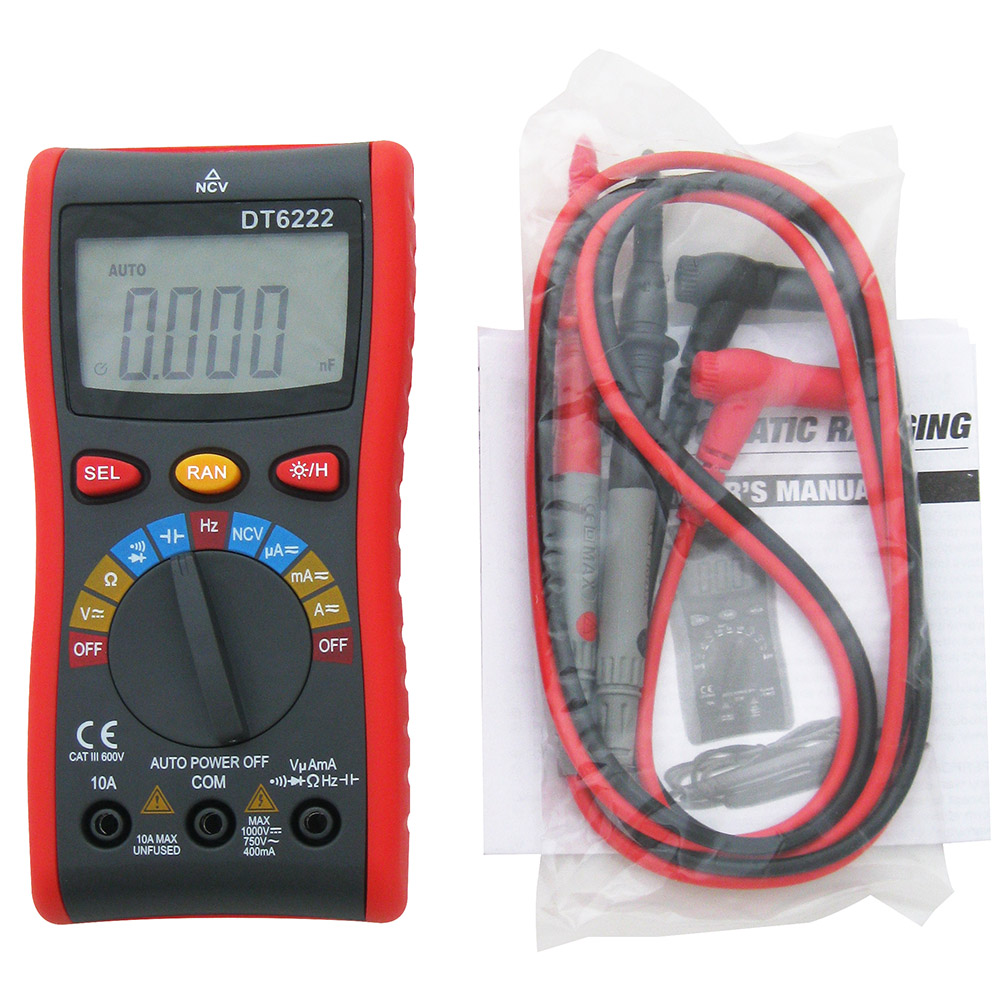
The commercial detail for a first order: it ships in a colour box, 60 pieces per carton, carton size 51.5 by 35.5 by 31.5 cm, gross 17.06 kg and net 16.38 kg. Standard accessories vary by market and by order, so confirm the packing list — meter, leads, holster, manual — with our sales team when you place the order. OEM branding and packaging are available, and every unit passes the same calibration and function check under CE and RoHS compliance before it leaves the factory.
Bench-Test a DT6222 Against the Meter You Sell Today
Order a sample DT6222 and run it on the checks your trade customers actually bring through the door: a voltage reading at a distribution board, a continuity check on a ring main, a capacitance measurement on a failed motor capacitor, and a frequency reading on a drive output. Compare the ±0.7% frequency figure against whatever you stock now, because that is usually where the difference shows. Then send us what you measured, the panel work your customers do and the quantity you are planning. Our Wenzhou engineers reply within 24 hours, confirm whether the DT6222 fits your line or point you to the VC17B+ when the job also needs temperature, and quote per-unit pricing once we know your numbers.