

A Multimeter for Car Battery Work: What the Specification Has to Say
For car battery work the part of the specification that decides the purchase is the DC voltage range above 20 V, the resolution available on that range, and whether the display survives a dark engine bay — not the number of functions printed around the dial. A meter that answers 12.6 V to within 10 mV, holds that number steady while someone cranks, and can be read under a bonnet at night does the job; a meter with twenty functions that resolves only 100 mV on the range it will actually be used on does not. Everything else on the dial starts to matter only after the job moves from a battery check to a drain hunt, and that is a different purchase.
DC Volts Above 20 V Is the Range You Will Use
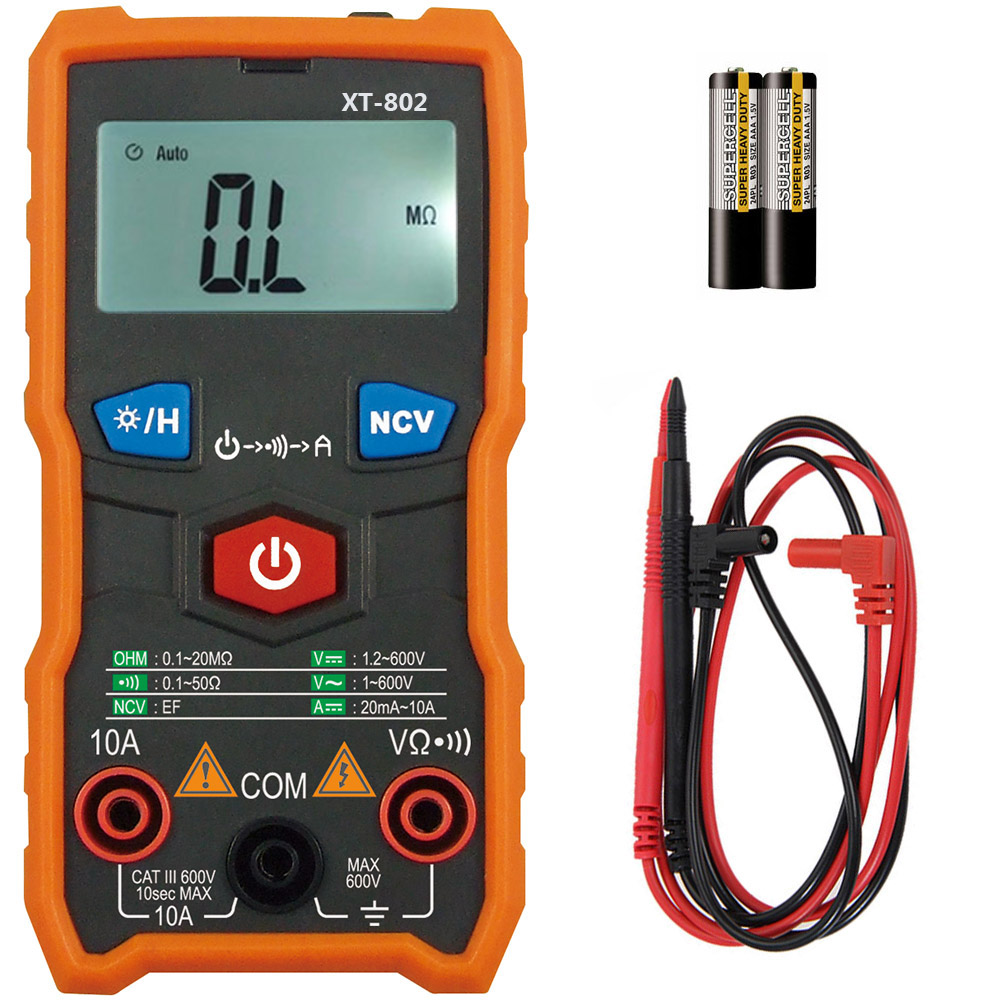
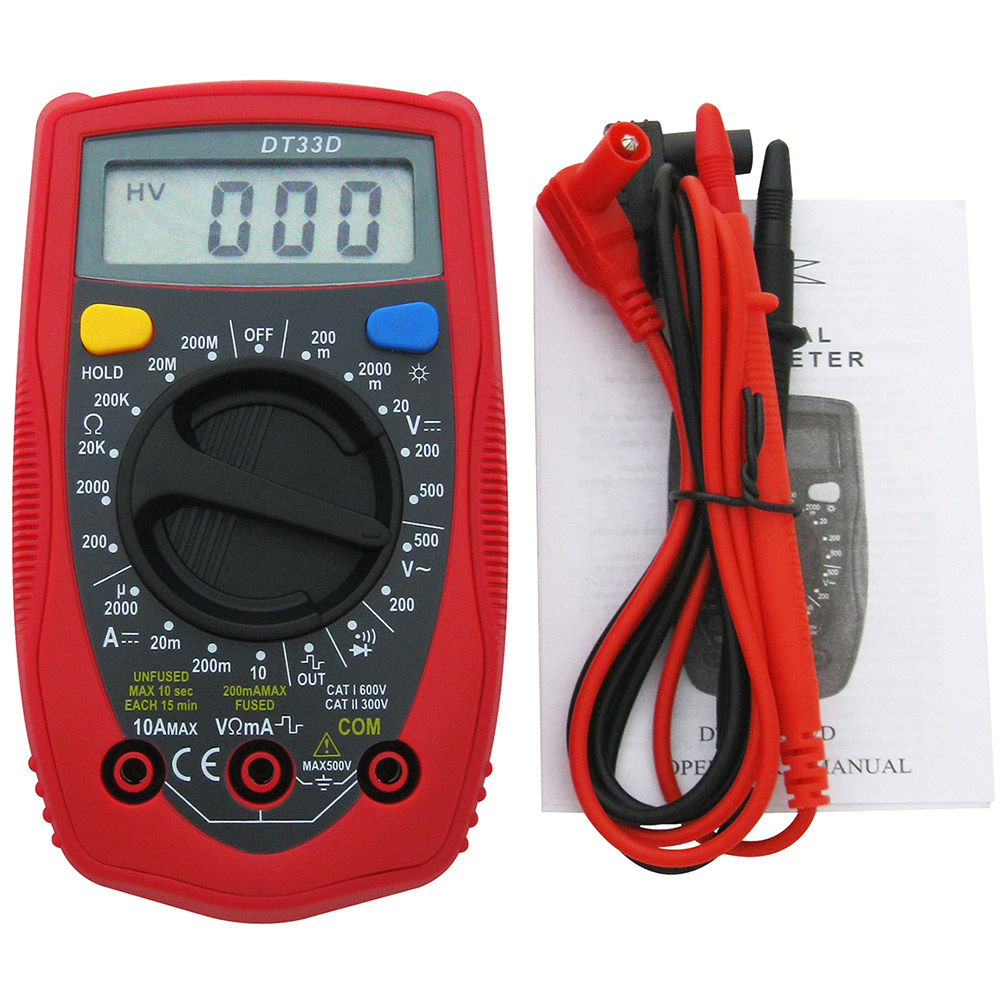
A 12 V lead-acid battery at rest sits at 12.6 V, an alternator pushes 14.4 V, and a charging fault shows up as 13.2 V. All three live in the same narrow band, and all three are meaningless if the meter’s neighbourhood resolution is 0.1 V. On the DT33 series the 20 V range carries a 10 mV step; on the DT6222 and the XT802 the range that covers a 12 V system does the same. Whatever meter is chosen, the requirement is one line long: DC volts, a range that reaches comfortably past 20 V, and 10 mV on that range.
Counts Are Sold as a Headline and Rarely Decide Anything Here
A 1999-count meter and a 6000-count meter both display 12.60 V with the same number of digits when both are on a range above 20 V; the extra counts buy resolution on the low ranges, which a battery check never visits. What separates them on this job is accuracy, and accuracy is the plus-or-minus figure the spec sheet prints rather than the count. The DT33 is specified at 1.0 percent on DC volts, the XT802 at 1.3 percent and the DT6222 at 1.8 percent. At 12.6 V those tolerances are roughly 0.13 V, 0.16 V and 0.23 V, which is the width of the band the meter can honestly distinguish — a real consideration when the decision hangs on whether a battery reads 12.24 V or 12.45 V, and irrelevant when it reads 11.9 V.
Autoranging Is a Convenience, Manual Ranges Are Not a Handicap
Most of the battery checks in a workshop are the same measurement repeated on different vehicles, and for that a manual range set once and left alone is faster than a meter that steps through ranges every time the probes move. Autoranging earns its place when the meter is passed between jobs of different scale — a 12 V battery one minute and a 400 mV sensor signal the next. Neither arrangement changes what the instrument measures, and a buyer choosing on this feature alone is optimising the wrong line of the specification.
What a Battery-Test Position Actually Measures
A battery-test position applies a fixed resistor across the cell and reports the result as good, weak or replace. On the DT33B that position is marked for 1.5 V, 9 V and 12 V, and it is genuinely useful for sorting dry cells at a counter. For a car battery the load it applies is far too small to say anything about cranking capability, and the verdict it returns cannot be compared against a published state-of-charge table. Treat it as a quick screen on a small cell and use the DC volts range, plus the cranking reading, for anything with a starter attached.
A Clamp Meter Is the Wrong Second Instrument for This Job
A clamp measures current, and a battery check needs voltage. The clamps most workshops own are AC-only and will read zero on a DC starter cable; a DC-capable clamp that resolves the tens of milliamps a sleeping vehicle draws is a considerably more expensive instrument than the one in the toolbox. Starter current in the hundreds of amps is normally measured with a dedicated load tester or a conductance tester rather than a clamp, and the only place a clamp earns its keep on this job is a drain hunt where the meter has a millivolt or milliamp range that can resolve the draw — which is the subject of the parasitic draw test and of which current jack the reading comes from.
The Meters We Build, and Where Each One Fits
Four instruments come up in this conversation, and they are not interchangeable. The table gives the specification line that matters for battery work and the job each one is actually for; the full specification for each is on its product page, and the digital multimeter selection guide covers the rest of the range if the job grows past a battery.
| Model | DC volts, accuracy, counts | Where it fits |
|---|---|---|
| DT33B | 200 mV to 500 V, 1.0 percent, 1999 counts, 1.5 V / 9 V / 12 V battery test | Battery checks, continuity and mains voltage on a single bench |
| DT6222 | 400 mV to 600 V, 1.8 percent, 4000 counts, microamp and milliamp ranges | Battery check plus the drain hunt that follows it |
| XT802 | 6 V to 600 V, 1.3 percent, 6000 counts, backlight and data hold | Dark engine bays and anywhere the voltage figure has to be trusted to 10 mV |
| BT-168 | 1.5 V and 9 V cells only, good / weak / replace | Sorting dry cells; not a 12 V lead-acid battery |
| Battery Meter L | 1.5 V and 9 V cells only, good / weak / replace, 48 g | Bulk bench checking of dry cells before they go back on the shelf |
Tell Us the Vehicle and the Job
The right meter for a workshop that checks batteries before a service is not the right meter for one that chases intermittent drains, and the difference is a specification line rather than a price bracket. Send us the vehicles, the jobs and the market you sell into, and the engineers in our Wenzhou factory will point to the model that covers them without paying for ranges nobody will use; samples are available for evaluation before any order, and replies come back within 24 hours.